
A New Era for LSU’s Wetland Biogeochemistry Analytical Services Lab
August 28, 2026
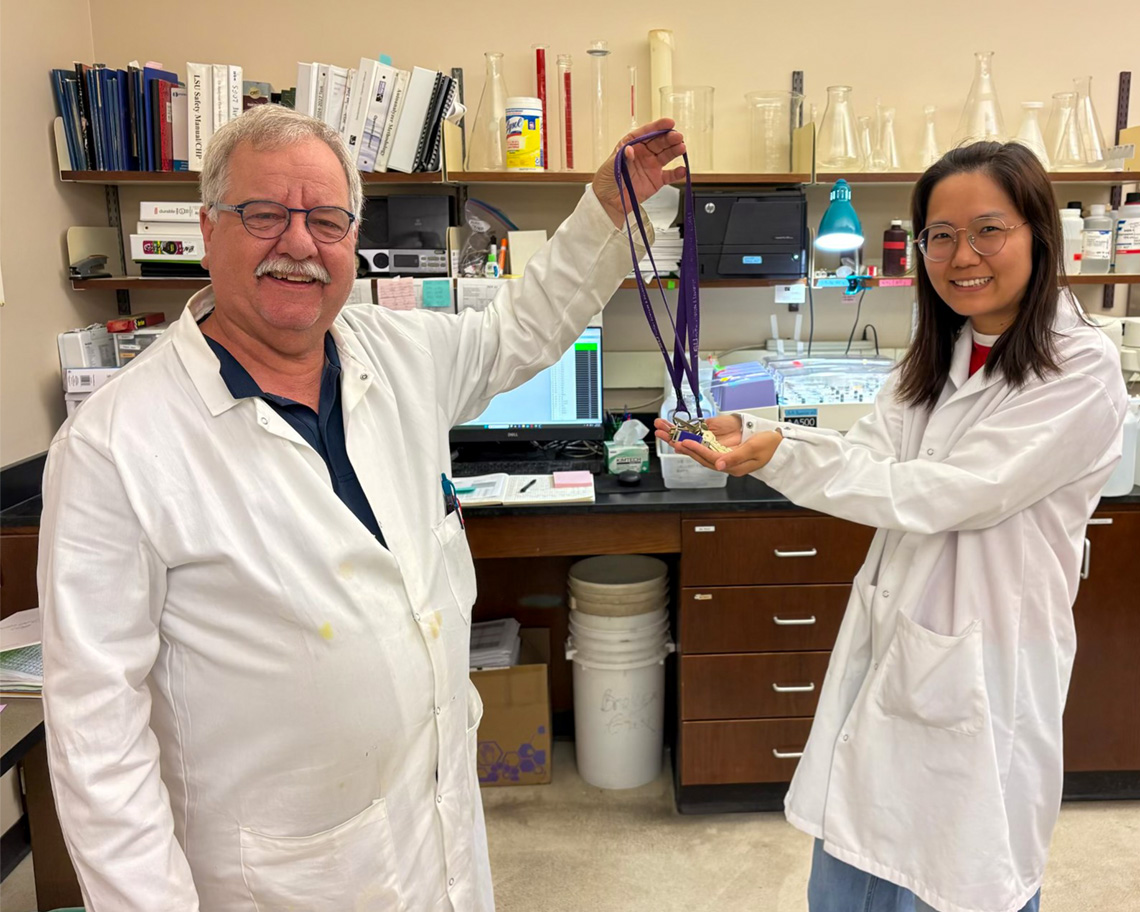
WBAS manager Tommy Blanchard hands the keys to the lab over to the next generation of leadership, new lab manager Song Li.
BATON ROUGE - For more than two decades, LSU’s Wetland Biogeochemistry Analytical Services Laboratory (WBAS) has provided the chemical analyses researchers need to better understand Louisiana’s environment—from water quality and coastal ecosystems to economically important fisheries and environmental health.
Housed in LSU’s College of the Coast & Environment, WBAS is a self-funded, nonprofit analytical laboratory supporting research and teaching at LSU and beyond. As one of the most comprehensive laboratories of its kind in Louisiana, WBAS serves researchers across LSU as well as other universities, state agencies and industry from around the globe.
The laboratory specializes in analyzing nutrients and contaminants in water, soil, plants and animal samples using state-of-the-art instrumental and classical wet chemistry techniques. Its mission is straightforward but essential: provide researchers, industries and agencies with high-quality, reliable data using certified analytical methods.
“Beyond helping to address Louisiana’s environmental challenges, WBAS gives graduate and undergraduate students hands-on experience that connects fieldwork, laboratory analysis and scientific interpretation – skills that prepare them for careers in science, consulting, government and industry,” says Clint Willson, dean of the LS College of the Coast & Environment and associate vice chancellor for water and coast.
Building a Laboratory—and a Legacy
WBAS began in 2005 when Drs. Robert Twilley and Thomas “Tommy” Blanchard transformed aging equipment into the foundation of a new analytical laboratory that now performs more than $500,000 in analyseseach year. Blanchard, who joined LSU in 1998, helped build WBAS into the sophisticated research resource it is today.
After more than 28 years at LSU and more than two decades helping lead WBAS, Blanchard will retire in August 2026, leaving a legacy that extends well beyond the laboratory itself. The analyses conducted under his leadership have supported countless research projects and contributed to a greater understanding of Louisiana’s complex coastal and environmental systems.
“WBAS connects what we observe in the field to measurable environmental impacts, helping us better understand ecosystem health and function,” says John White, associate dean of research for the LSU College of the Coast & Environment. “Its reach extends far beyond Louisiana. The lab has analyzed samples from six continents. We’re just waiting on Antarctica.” Says John White, Associate Dean of Research, LSU College of the Coast & Environment.
A New Generation of Leadership
As Blanchard retires, Dr. Song Li, a research associate who has worked alongside him in WBAS, will assume leadership of the laboratory.
Dr. Li brings firsthand knowledge of the laboratory’s operations, analytical techniques and commitment to data quality. Under her leadership, WBAS will continue its core mission while building on the strong foundation established over the past two decades.
The transition marks both the end of an important chapter and the beginning of a new one—ensuring that LSU researchers and partners continue to have access to the high-quality analytical services needed to understand and protect Louisiana’s environment.