
An LSU Team Wants to Discover What Happens to Mosquitos after a Hurricane
August 20, 2026
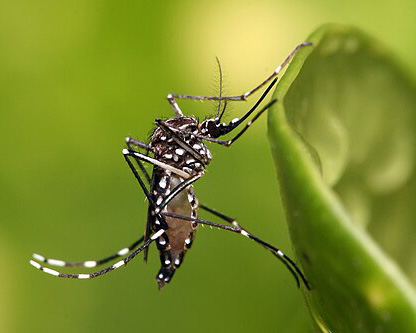
Ae Aegypti, also known as the yellow fever mosquito
– Photo credit: Wikimedia
When a hurricane strikes, the fate of a mosquito may not be the most pressing question on anyone’s mind.
What happens to them, however, may carry long-term consequences for the natural world, and public health.
Environmental Sciences Associate Professor Rebeca de Jesús Crespo and her lab are working on discovering the answer, as part of a multi-institutional study on better understanding how extreme weather impacts mosquitos and their life cycles.
The team is focused on the mosquito Ae Aegypti, in the city of New Orleans. Ae Aegypti, commonly known as the yellow fever mosquito, is the most competent vector – ie, successful disease spreader – for illnesses like Chikungunya, dengue fever and Zika.
Under normal circumstances, it is out-competed in the New Orleans area by Ae Albopictus, aka the Asian tiger mosquito. That species doesn’t spread those diseases as effectively.
de Jesús Crespo and her research team are hoping to understand whether a hurricane changes this equation.
Her students deployed artificial containers to see how defoliation and heat change the food available to mosquito larvae – part of an effort to understand how the ecological impacts of a storm may change the conditions that mosquitos reproduce in.
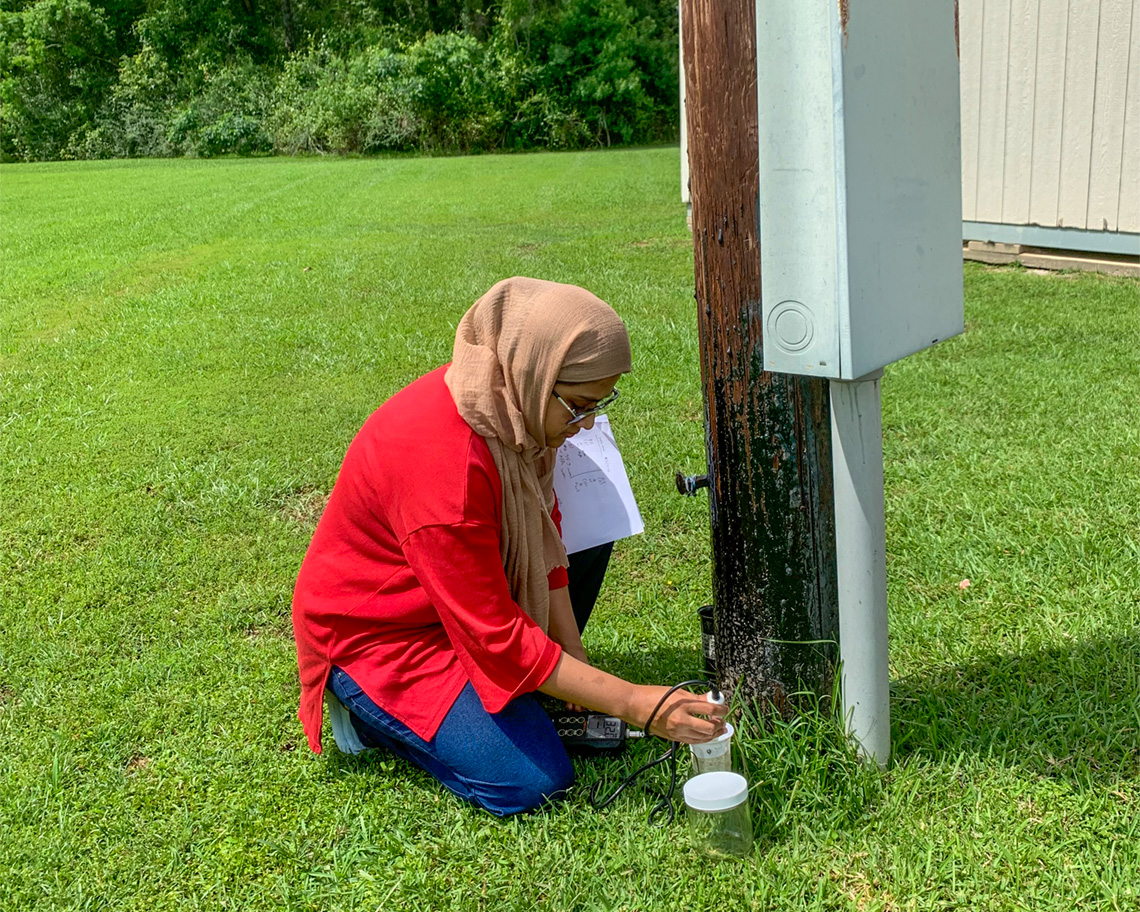
Graduate student Taherunnesa Rahi collects samples
– Photo Credit: Taherunnesa Rahi
Their results are being incorporated into a model that attempts to depict how post hurricane temperatures, as well as other changes, including human behavior, may alter the way diseases are spread.
Researchers from Virginia Commonwealth University and the University of Georgia are also working on the project, which is supported with a seed grant from the Burrows Welcome Fund.
"This has truly been a collaborative effort among ecologists, mathematicians, meteorologists, and most importantly city officials who have partnered with us to make this project possible,” said de Jesús. "We hope this seed grant can also be expanded in the future to continue learning more about how to address the compounding impact of outbreaks under climate hazard conditions.”