
Extending Louisiana's Eyes on the Gulf
July 02, 2026
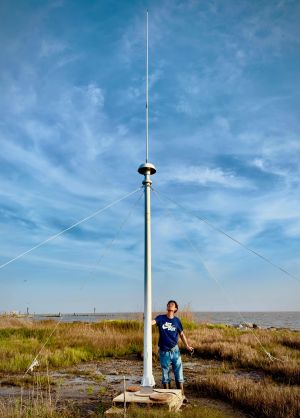
Through the newly funded Gulf Futures Challenge, Louisiana State University is expanding its role in Gulf Coast resilience by leading the design and deployment of High Frequency (HF) Radar systems on selected retired offshore platforms, extending ocean observations farther into the Gulf while strengthening regional coastal resilience.
– Photo Credit: Kevin Xu
As we celebrate Independence Day, we also celebrate the science and innovation that help safeguard our nation's future. LSU researchers are advancing cutting-edge ocean observing technologies that strengthen coastal resilience, protect critical energy infrastructure, and support the communities and industries that power America.
That spirit of innovation is reflected in LSU's latest research initiatives, where scientists are developing technologies that enhance both national resilience and economic security. One of the newest efforts extends the university's coastal observing capabilities from Louisiana's shoreline to the offshore energy platforms that help fuel the nation's economy.
Louisiana State University is expanding its role in Gulf Coast resilience through its participation in the newly funded Gulf Futures Challenge, supported by the National Academies of Sciences, Engineering, and Medicine's Gulf Research Program. Led by Drs. Chunyan Li and Kevin Xu, LSU is a subaward partner in the Gulf Offshore Research Institute's $20 million project, Repurposing Petroleum Infrastructure for Sustainable Energy, Food, and Critical Minerals. The project will investigate how retired offshore oil and gas platforms can be transformed into hubs for green hydrogen production, offshore aquaculture, marine habitat restoration, critical mineral recovery, and long-term ocean observing systems. As part of this effort, LSU will lead the design and deployment of High Frequency (HF) Radar systems on selected retired offshore platforms, extending ocean observations farther into the Gulf while strengthening regional coastal resilience.
This new initiative builds on LSU's growing expertise in coastal observing technologies. In 2023, the National Oceanic and Atmospheric Administration (NOAA) awarded LSU $5 million to establish Louisiana's first statewide HF Radar network. Led by Drs. Kevin Xu, Chunyan Li, Sam Bentley, Paul Miller, and Z. George Xue, the project will deploy up to eight CODAR SeaSonde radar stations capable of providing near-real-time measurements of ocean surface currents extending more than 100 miles offshore. These observations will improve hurricane forecasting, maritime navigation, search-and-rescue operations, oil spill response, coastal restoration, fisheries management, and emergency preparedness while filling a longstanding observational gap along Louisiana's Gulf Coast.
As the project has progressed, LSU researchers have successfully tested and demonstrated HF Radar systems at Sabine Pass, Cameron, Grand Chenier, Grand Isle, and Buras, validating the technology under Louisiana's challenging coastal and wetland conditions. These field deployments confirmed the radar's ability to continuously map ocean surface currents with high spatial and temporal resolution while operating reliably in Louisiana's hot, humid environment. Successful demonstrations at Grand Isle and Buras also verified dependable data transmission and system performance, providing confidence for expanding the network across both western and eastern Louisiana. Once fully operational, the statewide network will deliver continuous, real-time current maps to support coastal managers, emergency responders, mariners, researchers, and resource agencies. The system will also contribute data to NOAA's Integrated Ocean Observing System (IOOS) and the Gulf of Mexico Coastal Ocean Observing System (GCOOS), making Louisiana an integral part of the nation's ocean observing network.
Together, the Gulf Futures Challenge and the NOAA-funded HF Radar initiative position LSU at the forefront of coastal resilience science and technology. By combining advanced ocean observations with innovative approaches to repurposing offshore infrastructure, LSU is building the scientific foundation for safer navigation, more resilient coastal communities, sustainable offshore industries, and better-informed decision-making throughout the Gulf of Mexico. These complementary investments underscore the LSU College of the Coast & Environment's commitment to developing science-based solutions that address the Gulf Coast's most pressing environmental, economic, and resilience challenges while supporting the long-term sustainability of one of the nation's most valuable coastal regions.