
LSU Researchers Team Up with Ascension Parish to Put AI to Work Against Flooding
June 09, 2026
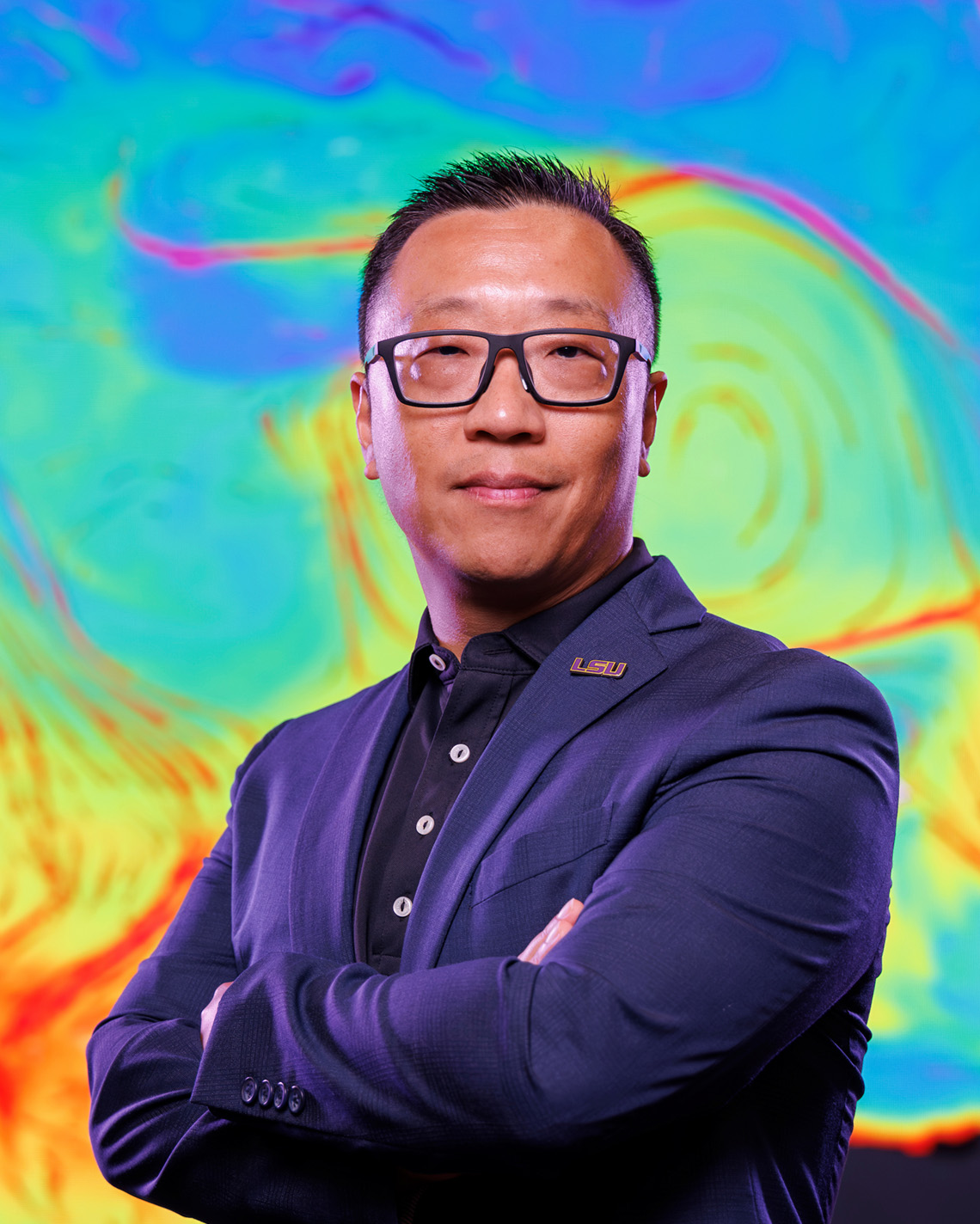
BATON ROUGE - Predicting floods with artificial intelligence is one thing. Training the AI to do it well is another.
That’s why Z. George Xue, a professor of Oceanography & Coastal Sciences, is putting a new AI powered flood prediction tool through its paces in a living Louisiana laboratory, less than 25 miles from LSU’s campus, in Ascension Parish.
Xue and a team of LSU researchers are working with Ascension Parish Government on a pilot project combining real-time drainage data, weather forecasting, and AI modeling, all to build a more predictive flood response system.
A Perfect Match
This predictive flood forecasting initiative is made possible by what officials call a “perfect match” – the combination of LSU’s artificial intelligence and modeling expertise and Ascension Parish’s high-tech, centralized drainage monitoring network, which provides the model with the critical information it needs to train effectively.
“One of the biggest challenges in AI flood forecasting is not building the model itself, but teaching the system how a real drainage network behaves under constantly changing conditions,” said Xue. “By combining real-time observations, weather forecasts, and AI modeling, we are working toward a system that can continuously learn from new events and provide more actionable flood intelligence for local decision-makers.”
The technology is intended to support, not replace, human decision-making.
“Humans will ultimately make the decisions, but this modeling will hopefully help us make better, more informed decisions based on historical data and actual events,” Parish President Clint Cointment said. “The goal is to predict conditions before they happen so we can respond more effectively and efficiently.”

The Marvin Braud pump station in Ascension Parish
– Photo Credit: Ascension Parish
Learning a Louisiana Landscape
Xue said the project is made possible by the amount of high-quality data Ascension Parish is able to provide.
“Traditional flood models are built mainly on physics, which works well at large scales but can struggle at the local level, where human interventions like pumps, gates, and weirs constantly reshape how water moves,” he said. “AI takes a different approach that it learns directly from how the system actually behaves based on the parish's real-time observation network.”
Right now, the flood tool is being calibrated and tested, as it learns how Ascension Parish’s unique drainage network reacts during different rainfall events and weather conditions. Drainage officials are comparing AI-generated forecasts against actual observed conditions to evaluate accuracy and continue refining the model.
Ascension Parish officials said the long-term value of the project lies not just in the flood forecast, but in understanding how the entire drainage system reacts in real-world conditions.
Forecasting for the Future
The model makes hourly forecasts based on live operational data provided by the parish’s expansive in-house data structure, which has grown significantly under Parish President Cointment.
The data structure pulls information hourly from over thirty facilities – flood gates, tilting weirs, rainfall gauges, stream-level monitoring stations and pumps, including integral data from the massive Marvin Braud pump station, which has seven pumps and can move up to 1,350,000 gallons of water a minute when working at full capacity.
The model combines this crucial data from the parish with information from the US Geological Survey and NOAA to issue an updated, localized forecast on local stream levels over the next 24 hours.
To maintain accuracy, Xue’s team retrains the model every day, feeding it observations from the previous day, as well as crucial historical operational data also provided by the parish. This ensures it learns both current patterns and events over time.
“Developing this model has taught me that accuracy depends not only on the AI method, but also on understanding the real drainage system behind the data,” said Muhamad Farid Geonova, an Oceanography & Coastal Sciences Masters student who helped develop the model as part of Xue’s Coupled Modeling Group. “We improve the model by repeatedly testing it against past storms, studying where the forecasts succeed or miss, and fine-tuning the machine learning model so it better fits Ascension Parish conditions.”
Long-term, the parish hopes to develop a publicly accessible dashboard that would allow residents to view AI-generated water-level predictions and flood-forecasting information in real time.
Xue said he hopes the final product will have benefits beyond Louisiana. “The methods we're developing here could eventually be valuable to other communities facing similar flood challenges.”