
Can Coastal Science Help Lower Louisiana’s Insurance Costs? LSU Thinks So
May 26, 2026
Louisiana’s homeowners know all too well that hurricane season can bring more than wind and rain. It can bring another painful insurance bill. As the state’s average home insurance climbs above $5,000 per year, roughly twice the national average, families are feeling the strain of a market still reeling from the devastating 2020 and 2021 hurricane seasons.
But LSU researchers believe part of the solution may lie in the coast itself. By better understanding flood mitigation, storm surge and coastal risk, they are helping pave the way toward lower losses and ultimately, more affordable insurance for Louisiana residents.
Against the backdrop of this inhospitable insurance market, LSU’s College of the Coast and Environment (CC&E) faculty and research staff help make meaningful advances to protect the state from future losses. Drs. Robert Rohli and Nazla Bushra have helped quantify the financial benefits of flood mitigation. Their work, which includes team members from the LSU AgCenter, demonstrates that incorporating "freeboard"—the elevation of a home above the base flood level—serves as a wise investment rather than just an upfront cost. By demonstrating that a homeowner’s personal risk exposure follows an exponential decay trend as freeboard increases, the faculty provide the mathematical argument to justify premium discounts for elevated homes. Ultimately, this research provides motivation for mitigation programs, showing that elevated infrastructure can serve as an effective path toward market stability and lowering costs for residents.
“ Accurate disaster preparedness, planning and decision-making can prevent structural damage during hurricanes, reducing the insurable losses that cause rate hikes. ”
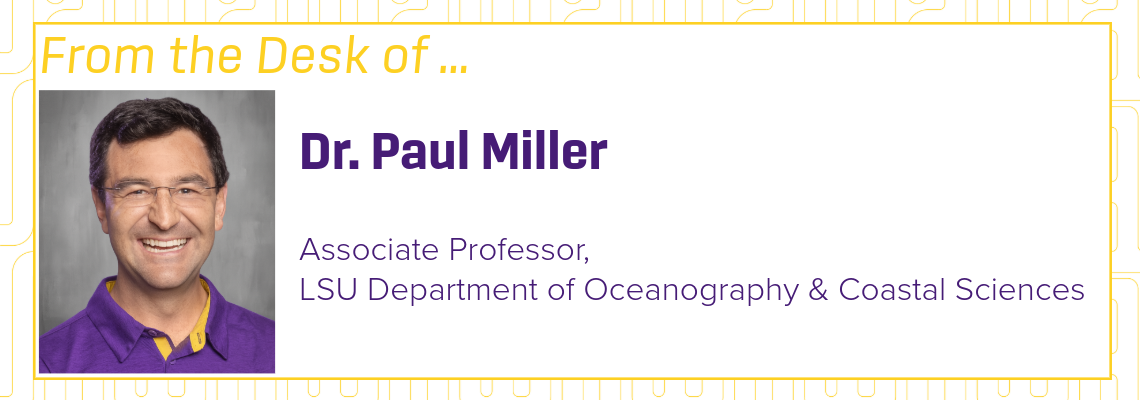
Living and working near the mouth of the Mississippi River and its associated delta gives CC&E faculty a "ground-truth" advantage in coastal meteorology. For instance, faculty like Dr. Zuo "George" Xue are pioneering the use of "Digital Twins" and AI-driven forecasting which can be used to design life-saving coastal infrastructure. Similarly, Drs. Paul Miller and Robert Twilley serve critical roles with LSU’s Coastal Emergency Risks Assessment (CERA) platform, which is used by state officials to determine which surge barriers and flood gates should be activated in advance of imminent hurricane landfalls. Accurate disaster preparedness, planning and decision-making can prevent structural damage during hurricanes, reducing the insurable losses that cause rate hikes.
This scientific leadership benefits Louisiana by bringing additional risk clarity to its local insurance market. Hydrodynamic modeling and wave monitoring by CC&E experts like Drs. Chunyan Li and Haosheng Huang can help ground insurance premiums with data-driven practices. Meanwhile, in the LSU Earth Scan Laboratory, Emeritus Professor Dr. Nan Walker tracks the Loop Current and warm-core eddies. By understanding how these deep pools of warm water fuel rapid intensification, CC&E helps weather forecasters anticipate the circumstances in which storms may pose particularly potent threats to the coast.
By embracing its commitment to “build teams that win for Louisiana and the world,” CC&E faculty continue to perform transformative research that help turn Louisiana’s coastal vulnerabilities into a transparent and manageable financial risk.