
How LSU’s College of the Coast & Environment Is Protecting Public Health from Environmental Exposure
April 09, 2026
The Hidden Side of Public Health
When most people think about health, they picture doctors, hospitals, and the human body. But in Louisiana, where the air, water, and land are woven into daily life, public health is also shaped by what’s in our environment. Chemical contaminants—often invisible and silent—can have a profound impact on our well-being.
Why Environmental Exposure Matters to Louisiana
Louisiana is a state defined by its waterways and coastlines. From fishing in the bayous to boating on the lakes, water is at the heart of our culture and economy. In 2025 alone, Louisiana produced a staggering 850 million pounds of seafood, second only to Alaska. Residents here eat more fish and shellfish than almost anywhere else in the country.
But this close relationship with nature comes with risks. Our rivers, lakes, and air can also carry chemical contaminants—byproducts of industry, agriculture, and urban life. According to the Institute for Health Metrics and Evaluation, these contaminants are a leading cause of chronic diseases like heart disease, diabetes, cancer, and even mental health disorders.
Louisiana is home to one of the highest concentrations of chemical manufacturing plants in the U.S. About 37% of residents rely on surface water—rivers, lakes, and bayous—for their drinking water. This means that what happens upstream, in the air, or in the soil, can affect the health of families across the state.
How Did We Get Here?
Louisiana’s unique geography and booming industries have shaped both its prosperity and its environmental challenges:
- Industrial Growth: The state leads the nation in manufacturing revenue per capita, with 15 oil refineries, over 150 petrochemical plants, and more than 300 manufacturing facilities.
- Natural Factors: High temperatures, frequent storms, and diverse soils make it easier for contaminants to move through air and water.
- Major Waterways: The Mississippi/Atchafalaya River Basin, one of the world’s largest, drains into Louisiana, bringing with it pollutants from across the country.
- Accidents and Spills: Louisiana regularly experiences oil and chemical spills, adding to the burden on its environment.
These factors combine to create a complex web of exposure risks for people, wildlife, and the environment.
CC&E’s Response: Science in Action
At LSU’s College of the Coast & Environment (CC&E), researchers, students, and community partners are working together to tackle these challenges head-on. Here’s how:
1. Cutting-Edge Research and Training
- State-of-the-Art Labs: CC&E trains the next generation of scientists using advanced analytical instruments to detect and study contaminants.
- Innovative Studies: Research covers everything from “forever chemicals” like PFAS and pesticides in seafood and water, to air pollution and persistent organic pollutants.
2. Community Engagement and Support
- Monitoring Programs: CC&E helps communities monitor their air and water, providing data and expertise to local residents and agencies.
- Education: High school students can participate in hands-on programs, learning how environmental science can protect their families and neighborhoods.
3. Real-World Impact
- Disaster Response: For over 25 years, CC&E has supported emergency responses to chemical spills, working with NOAA and the U.S. Coast Guard across all 50 states.
- Tracking Emerging Threats: After the Smitty Supply explosion on the Tangipahoa River, CC&E monitored PFAS and petroleum contamination, studying how these chemicals move through water and accumulate in fish and shellfish.
- Air Quality: CC&E tracks air pollution in regions that don’t meet national standards, helping to identify and address challenging areas.
4. Addressing the Opioid Crisis - Environmental exposure is not just about chemicals from factories. CC&E is also helping to combat Louisiana’s drug overdose crisis by:
- Testing Wastewater: Measuring drug residues in wastewater to understand community-level drug use.
- Predictive Modeling: Working with state health authorities to develop models that predict overdose risks, helping to save lives by targeting resources where they’re needed most.
Meet the Experts
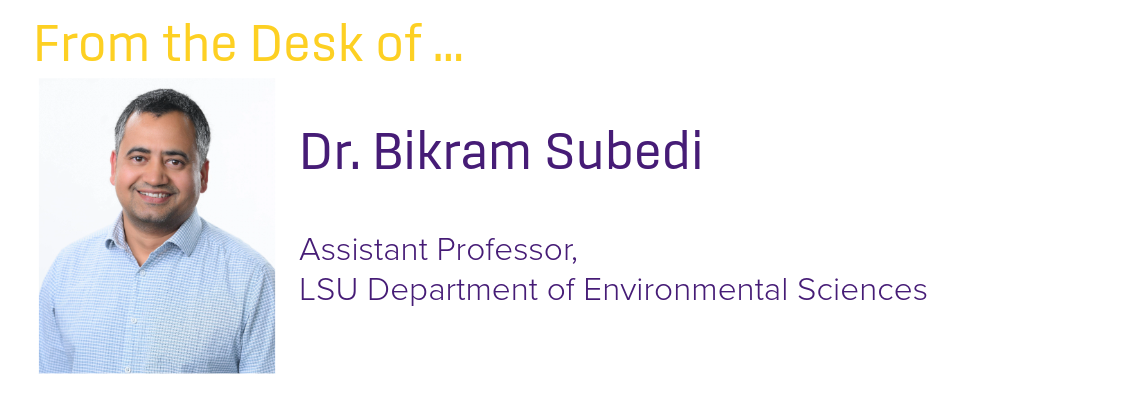
CC&E’s work is led by a team of dedicated scientists, including Dr. Bikram Subedi, Dr. Slawo Lomnicki, and Dr. Kevin Armbrust, who specialize in understanding how contaminants move through the environment and affect public health.
Why It Matters
By combining research, education, and community action, CC&E is helping to ensure that Louisiana’s unique way of life—rooted in its land and water—remains safe and healthy for generations to come.