
Teaching Beyond the Textbook: CC&E is Reshaping Environmental Science Education
April 20, 2026
At LSU’s College of Coast and Environment, or CC&E, environmental science is being transformed for the next generation. By opening doors to a wider range of students, modernizing courses, and forging powerful partnerships, CC&E is creating a dynamic learning environment where students do more than study science, they experience it.
From hands-on research and personalized mentoring to innovative curriculum enhancements
that weave in artificial intelligence, CC&E empowers students to dive into real-world
environmental challenges from day one, both inside and outside the classroom.
Preparing Students with Research and Real-World Experience
Student research remains central to the CC&E experience. With assistance from Dr. Giulio Mariotti, undergraduates join faculty labs as early as their first year, gaining real scientific experience that strengthens their critical thinking, problem‑solving and technical skills. These opportunities build confidence, expand networks and prepare students for careers or graduate study. One example is Katy Aranda, an undergraduate researcher in Dr. John White’s Wetland and Aquatic Biogeochemistry Laboratory.
CC&E also hosts an undergraduate research symposium, where students summarize their research project on a poster and present it to faculty, peers and visitors. This event sharpens communication skills, enhances resumes and sparks new collaborations. Many students go on to present at campus-wide symposiums and professional conferences, broadening their visibility and reinforcing the impact of their work.
Expanding Access and Early Engagement
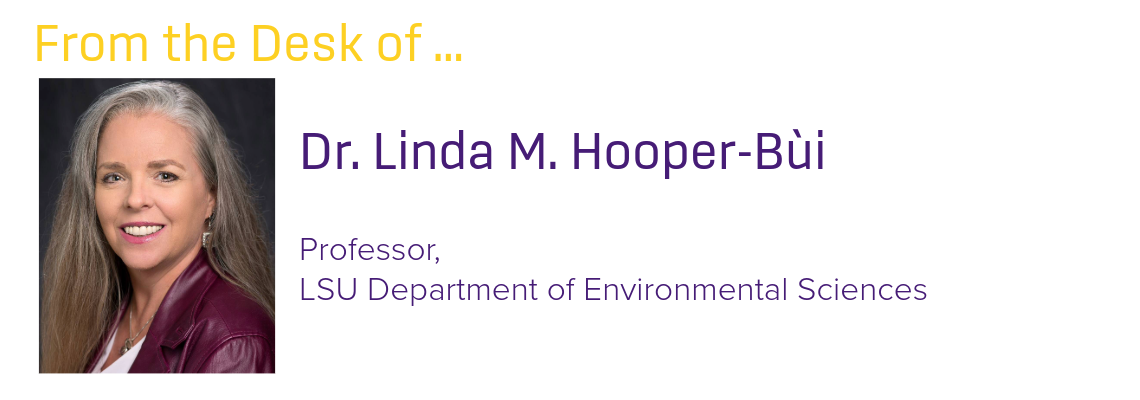
Beyond lab research, Dr. Linda Hooper-Bui and colleagues are defining environmental science education. Partnering with the LSU Office of Undergraduate Research and seven colleges, Bùi is creating new, accessible pathways into science. Supported by a 2022 National Academies of Sciences grant, the Gulf Scholars Program offers students from any undergraduate major a cohort-based mentoring experience with immersive projects, courses and activities focused on Gulf Coast communities, ecosystems and industries.
Application workshops and peer-to-peer recruiting to open the program to students who might not otherwise see themselves in science or who lacked the knowledge and skills to apply for such a competitive program. The result is diverse cohorts and broader participation that are aimed at reshaping the scientific workforce for generations, not simply expanding it.
In June 2025, the college hosted its first Coast and Environmental Science Summer Camp for high school students. This college access program allows campers to take part in an engaging mix of nature-based and indoor activities, included guided hikes by two energetic faculty members, Dr. Brian Snyder and Dr. Sibel Bargu-Ates, and sampling expeditions, lab-work experiences and other structured activities.
In collaboration with the LSU Gordon A. Cain Center for STEM Literacy, CC&E has opened Introduction to Environmental Science to Dual Enrollment for high school students. Besides allowing high school students to get ahead on general education and college credits, dual enrollment allows high school students to see themselves as college students and as environmental scientists. Furthermore, it allows high school students to have college access without penalty, to pursue rigor without risk, and reduces the fear of failure. For CC&E, it brings new students to its undergraduate programs.
Integrating AI, Data Science and Environmental Knowledge
In an upper division Applied Ecology course, Bùi designed a new module with her teaching assistant, Dr. Owhonda Ihunwo, to integrate AI, data science, and environmental knowledge. Students remarked that being given a scenario, a hypothesis to test using AI, and a complex dataset was one of the most valuable parts of the course. They learned how to “vibe code” (code for an analysis they wouldn’t normally have the skills to do), create complex graphs and interpret them, and how to prompt AI to correct the initial analyses.
Through work with the Cain Center and colleagues including Assistant Professor Dr. Jon Doering, CC&E is redefining scientific literacy for the AI era. By building tools like the Personalized AI Learning (PAL) agent, CC&E trains students to analyze real, large environmental datasets (water quality, hydrology) while embedding AI ethics, validation, and guardrails. These efforts ensure future scientists are not just domain experts, but computationally fluent and critically aware.
Connecting Science to Society
Bùi is preparing for the commemoration of the Great Mississippi River Flood of 1927 by connecting this historical event to modern climate risk, grounding science in real-world problems and incorporating this work in middle and high school curricular modules. Further, a lower division course, Environmental Thought, has been retooled to focus on the 1927 flood and teach students to archive their experience with urgent, place-based environmental challenges using Louisiana’s flooding and water quality crises as teaching platforms. With classes like Environmental Thought, Applied Ecology, and Integrated Environmental Issues, students are engaged in authentic data, fieldwork, and restoration science that includes policy, infrastructure, and community resilience.
Through the Rural Scholars Initiative, led by Professor Linda Hooper-Bùi, Professor Emeritus Nina Lam and Associate Professor Rebeca de Jesús Crespo, LSU students are learning to bridge the gap that can occur between researchers, policy makers and rural communities. Rural Scholars also help communities gain access to new resources and provide a platform that gives voice to communities’ concerns.
Conclusion
The programs above all have one thing in common: blending disciplines into transdisciplinary thinking. The goal is to train scientists to think across boundaries, not within silos. Doing so produces scientists who can translate, collaborate, and lead, not just specialize.
CC&E is training the next generation of scientists by broadening access, modernizing skill sets (AI + data + ethics), embedding science in real societal challenges, teaching across disciplines, and building scalable educational systems through collaborations with the Cain Center. The goal is to shift science from something students learn about to something they actively use to understand and change the world they live in.