
What does the future hold for Louisiana’s coastal wetlands? An LSU Team Investigates
March 02, 2026
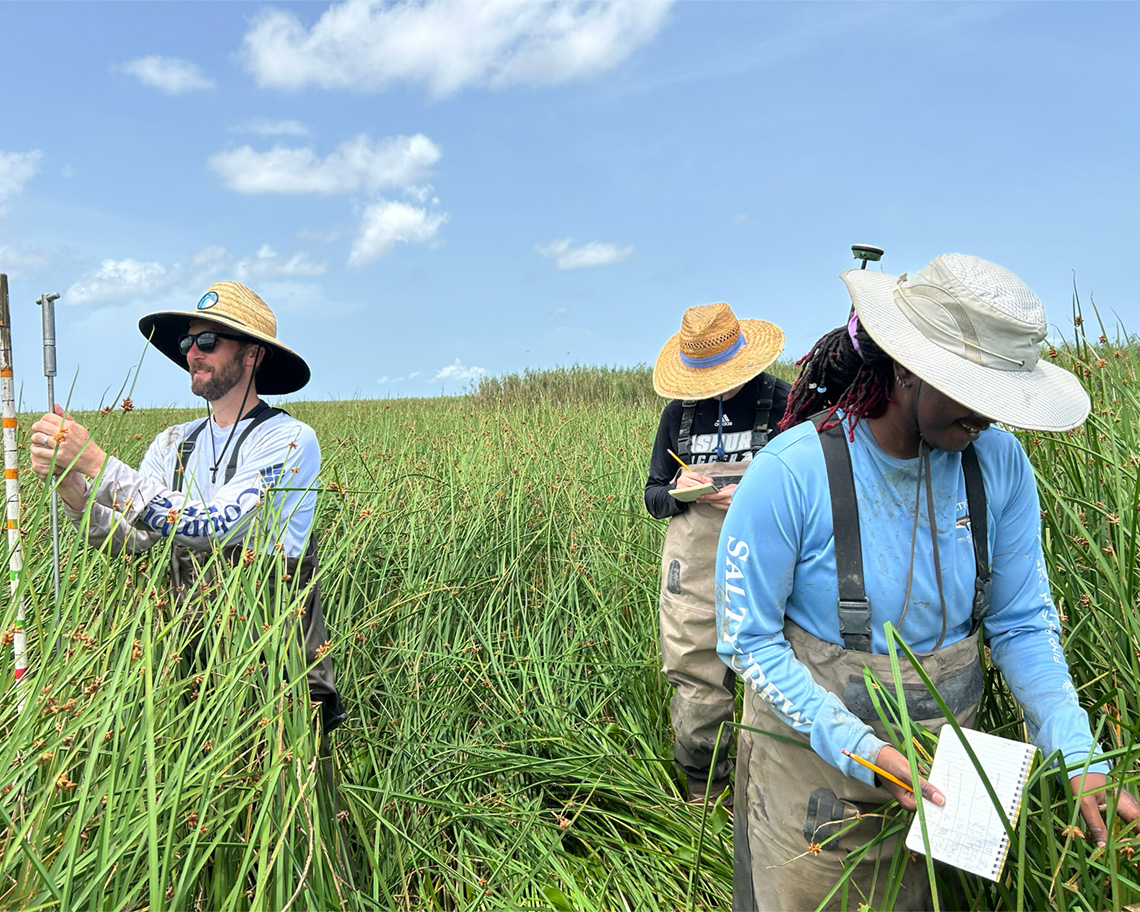
Members of Tracy Quirk's Wetland Plant Ecology Lab conduct field research.
BATON ROUGE - A grain of sand weighs more than a grain of mud. The difference is literally micrograms, but for the LSU scientists studying marsh land building on the Louisiana coast, it’s worth taking into account.
DOCS Associate Professors Matt Hiatt and Tracy Quirk, along with Geology and Geophysics Associate Professor Carol Wilson are working to paint a complete picture of how coastal wetlands help create land by gathering data on factors as minute as grain size.
It’s part of their work with the Mississippi River Delta Transition Initiative, or MissDelta – a fourteen-institution consortium dedicated to forecasting the future of the Birdsfoot Delta, one of the most endangered landscapes in North America. The team is working on one of 23 focus areas, known as subtasks, on the project. Subtasks cover everything from precipitation changes in the Mississippi River Basin to sea floor geology to socio-economic considerations.
Naturally coastal wetlands play a big role in the project, just as they do in the Birdsfoot area. They are also highly susceptible to the kinds of environmental changes it’s currently experiencing, from sea level rise to lack of sediment and land subsidence – all a central part of the team’s research focus.
"The amount of sediment carried from the channels of the Mississippi River Delta to the marsh interiors is key in determining whether the land in the Delta can keep pace with relative sea level rise,” Hiatt said. "Our work aims to find the key factors in regulating that transfer.”
The collaboration between Hiatt, Wilson and Quirk examines the wetlands as a land building system, where sediment carried by water may be deposited or trapped by the roots of plants, or continue to flow out into the Gulf, all depending on conditions in the surrounding area.
Hiatt studies the flow of sediment and water. His lab takes into account the aforementioned particle grain size – which matters because sand settles more quickly than mud - as well as the direction and rate of water flows, and a variety of other factors.
“My work is very much concerned with how vegetation density and seasonality interact with the hydrological conditions in the river to control that transfer of water and sediment," he said.
Wilson and her students are looking at landscape elevation and sediment deposition using tools like sediment tiles, which allow them to measure sediment accumulation of both organic and inorganic matter.
For her part, Quirk and her students are investigating the role plants play in where and how much sediment builds up in an area.
“We are in the field doing surveys of vegetation, elevation, soil and measuring accretion rates, in order to determine how marsh plants respond to their environment,” Quirk said. “Our work aims to understand how conditions such as flooding and salinity influence vegetation communities and productivity and in turn how the vegetation influences processes such as accretion to ultimately guide management and restoration objectives.”
Once the team’s investigations are done, the information they gather will be given to the MissDelta Initiative’s modeling team.
It will be used to train high powered computer models replicating conditions in the Mississippi River’s basin, delta and the northern Gulf. These models will then power simulations of different future scenarios in the Birdsfoot, with the intention of helping decision makers determine how to best manage the area going forward.