
DOCS Graduate Student Leads Team to Victory in Soil Judging Championship
November 09, 2026
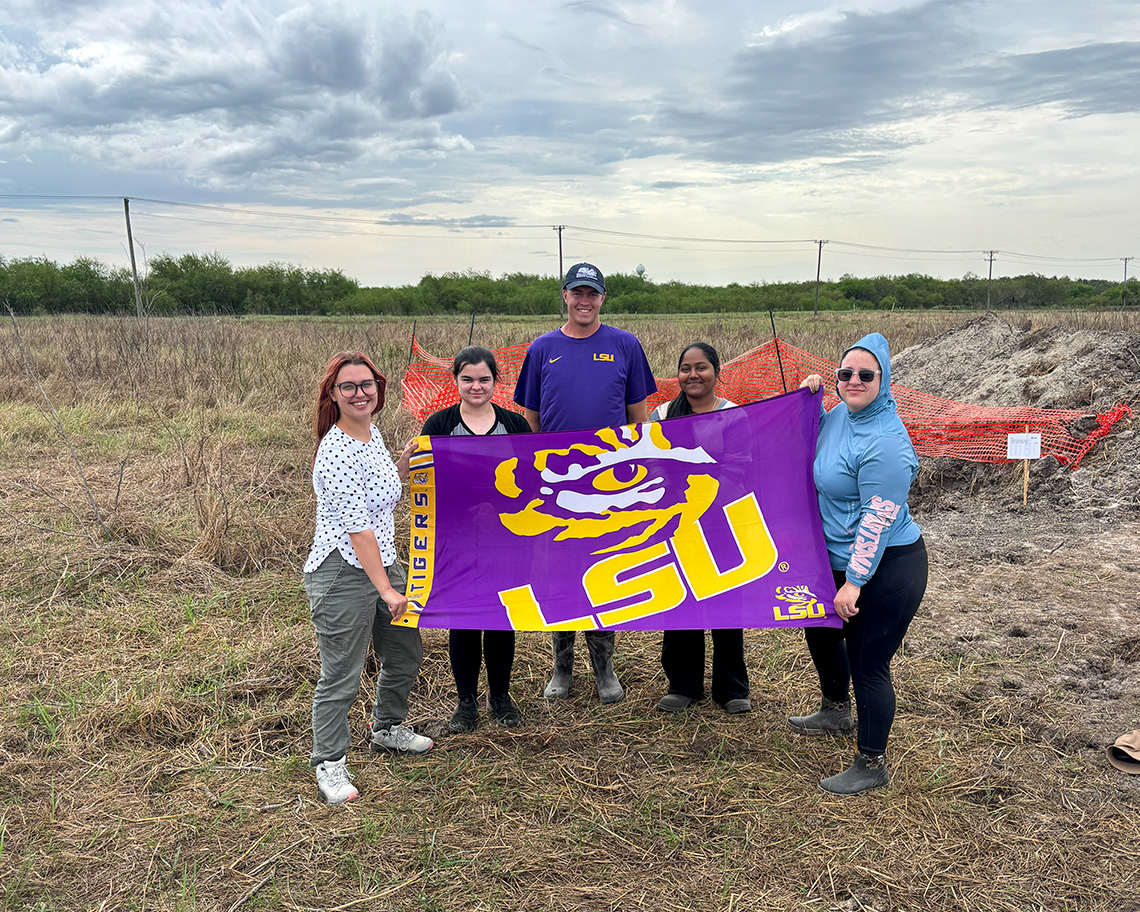
The competition marked Brye's (center) first time leading a team to a soil judging competition.
BATON ROUGE - Oceanography & Coastal Sciences PhD student Jonathan Brye is leading a team to the ‘ship – and this one’s going to get dirty…
Brye, who studies wetland soils with DOCS' Professor John White, recently led a team of undergraduates to the kind of victory an LSU team hasn’t seen in a while – in the Region IV Collegiate Soil Judging Contest in Texas.
The team won first overall and 2nd in the team judged portion. Undergraduate Kaitlyn Giesler had the highest overall individual score, and Taylor Eubanks took fourth place in individual scores. Both Giesler and Eubanks are in the College of Agriculture.
They are now invited to the national competition, to be held in Colorado in the spring. Brye says they plan to be there.
Althought he has competed extensively in soil judging, this marks his first official time coaching.
“Winning was nice because it highlights the student’s progress towards learning and understanding soil profile description. It was difficult for me to be certain that my teaching choices were effectively resonating with everyone, so it was great to see them succeed in practice and at the contest. And while winning isn’t the main objective of soil judging, it certainly helps validate the hard work and time commitment that the students, professors, and I invested.”
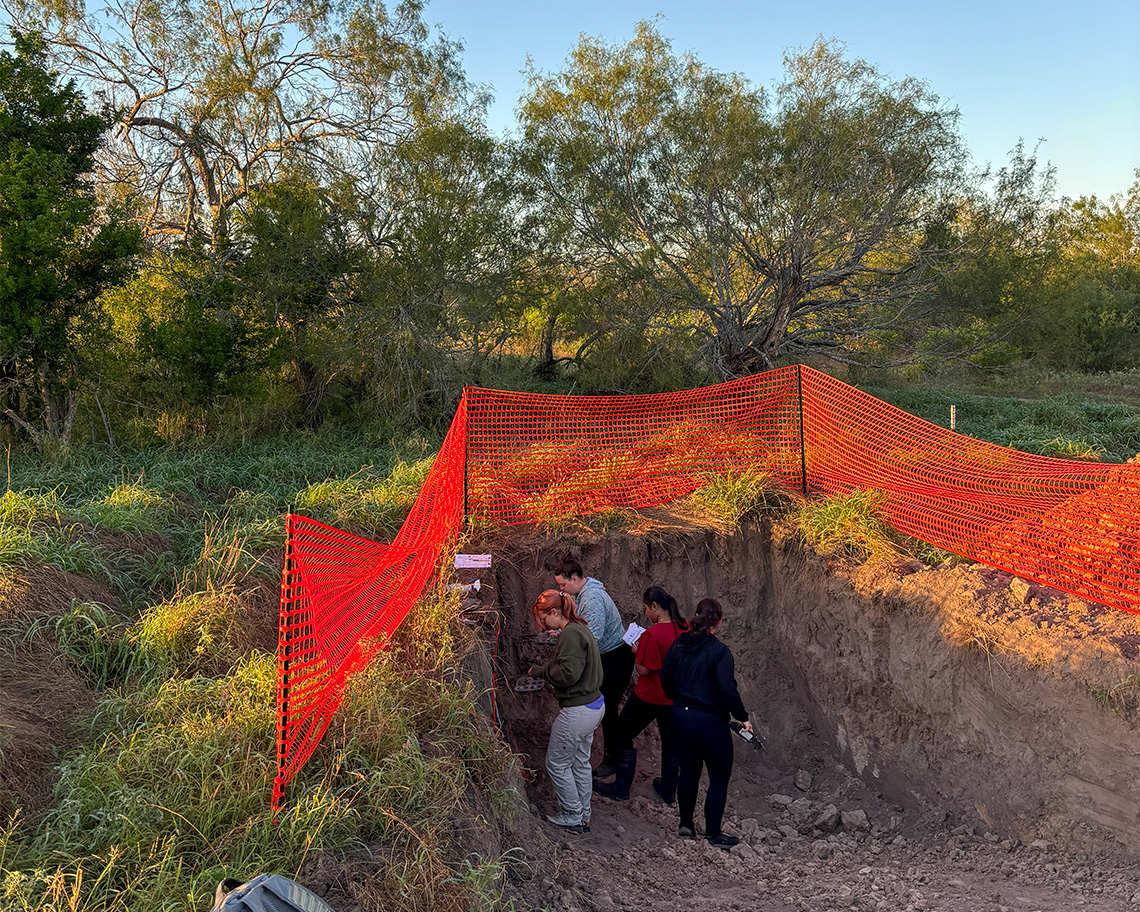
Soil is judged on everything from color and texture to wetness and parent material.
– Credit: Jonathan Brye
From color and texture to parent material
In soil judging, contestants enter pits excavated specifically for the competition, and work to describe the soil in the pit using a given set of criterion.
Participants describe soil based on a variety of factors: everything from basics like color and texture to more advanced features like wetness, structure and parent material.
“The most interesting part for me was being able to estimate the clay percentage just by touching and feeling the soil. It was amazing to see how much we could learn through hands-on observation,” said Keerthana Anandaswamy, who competed on the team.
Some of the challenges came from judging different types of soil than what students may be used to. “Texas doesn't have silt but Louisiana does. So that took a while to get used to because we had to classify everything as "fine sandy loam" or "loamy fine sand". There were a lot of jumps in clay percentages which was interesting,” said Madeline Tibbs, another team member.
“The most interesting part to me was the heterogeneity that could be observed both within a single soil profile and between soil profiles within a relatively small area. The biggest challenge for me was describing the soils within the allotted time, as you are only given 50 minutes per soil pit,” said Geisler.
“The soils in Kingsville that the students evaluated were mostly Mollisols in the plains of Texas. A mollisol is a mineral soil that is rich in organic carbon with a dark color in the surface,” said Brye. “Some of the soil pits we visited had accumulations of sodium, salts, and gypsum, as a result of being near the ocean, which was something neat that I hadn’t seen before!”
A Team Effort
“The goal of soil judging is that each person who participates in the class or attends the contest learns to incrementally understand the material and gain some confidence and experience that they can provide a reasonable soil description in a format that has applications to engineering, construction, septic system installation, and agronomy,” Brye said.
Brye expressed appreciation for the support provided by CC&E’s Jacob Berkowitz, and John White, and by the College of Agriculture’s Vinit Sehgal. “They were all crucial to ensuring the students had the resources necessary to learn and attend the contest. They all provided administrative support, resource allocation, and Dr. Berkowitz assisted me with describing the Louisiana soil’s and coaching the students’ multiple times leading up to our trip to Texas.”
Supplies and travel for the trip were funded by the LSU AgCenter.