
Science from an Industry Perspective: DES Student Reflects on Internship at Shell
January 14, 2026
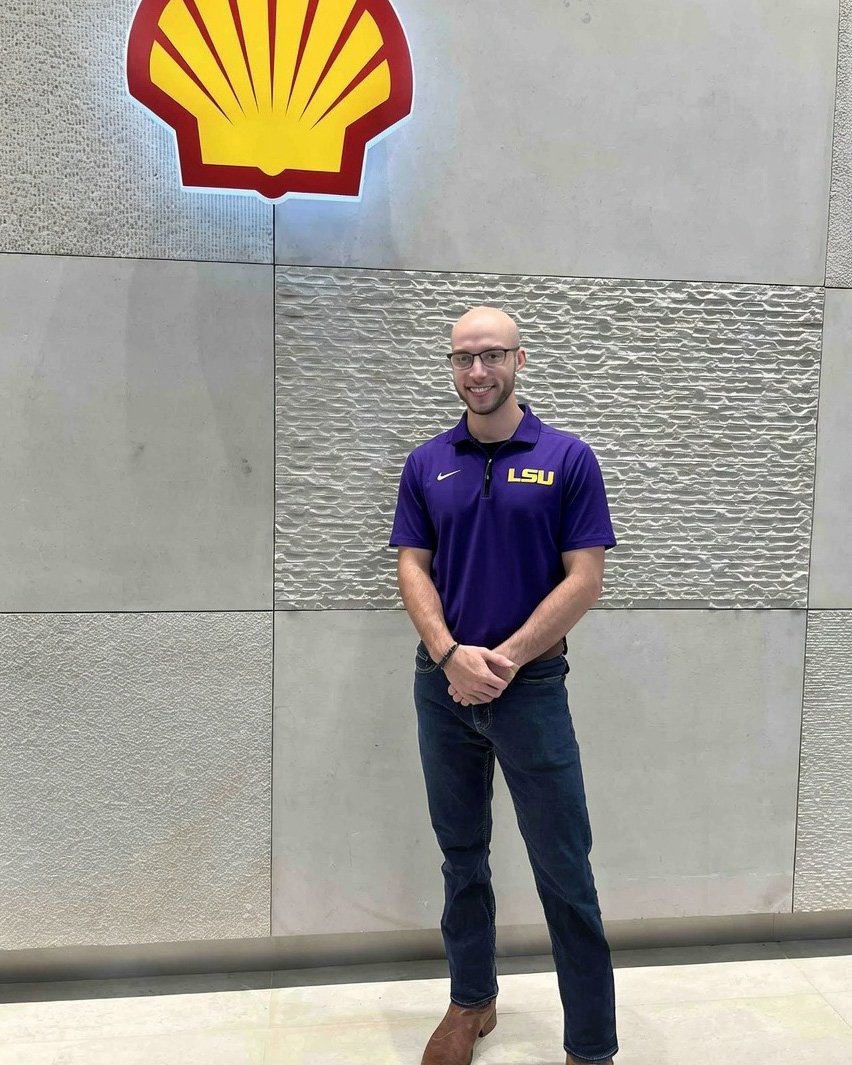
DES student Cameron Collins worked on three different projects during his five month internship at Shell.
BATON ROUGE - When Environmental Sciences PhD student Cameron Collins heard about the opportunity to intern with Shell Corporation, he knew he wanted to take it. His goal? To gain an industry perspective on scientific research.
“I have my experience here with academia. I've done an internship with NOAA before, but I didn't know about industry, so I wanted to get that experience,” he said.
Collins is training as an ecotoxicologist, working to determine the impacts of different chemicals on fish and animals in the environment, using less invasive methods than traditional animal testing.
Whether in the environment or in a pharmaceutical setting, we still need to know that products are going to be safe, even without animal testing, Collins says. “My research is developing ways that can fill in that gap. I use a lot of cell based assays. I use a lot of predictive modeling. I use a bunch of different techniques as substitutes or alternatives for traditional vertebrate testing.”
Three projects, three approaches
His time at Shell was not a standard internship. Rather than being assigned a single project to focus on, Collins was brought in on different projects when additional help was needed.
As a result, he says, “I had three different three projects focusing on three different subjects entirely in different states of completion. That was a gift. It definitely gave me a full, well rounded experience.”
One project asked him to complete a database intended for use by the general public, along with a guide to go with it. The second was related to his field of study, the development of an alternative methodology to traditional toxicity testing. “That was really cool… it was something I had seen developed in academia, and I was part of the transition [as] industry adopted it,” he says.
The third was working with discharge data from Shell’s US offshore assets, to determine what information was there, and what could be done with it. The combination of three projects gave him more insight than any would have alone.
“When I break down my three projects, they require three different technical approaches. The [database] was nearly complete…. [I]t's really just how to use it. The second one, we had data. We knew what we needed to do with it, but we didn't quite know how, and so that was my job. The last one was - we have data. We've been collecting it for, you know, five, six years, but no one's really looked into it to see what might be in here. What do we have?” Collins said.
The biggest key: communication
Throughout all three projects, Collins says one of the most important things he learned was communication, and that’s something he could only get by stepping outside the academic world.
“Communication is the biggest thing that you learn from stepping outside of your own bubble. It's not just showing, hey, this is how it's used. It's also explaining to someone that's not a toxicologist how you use it.” He said his time at Shell confirmed how necessary good communication is. “Out of all my teams [at Shell], there's only six or seven people that know exactly what I'm saying at all times. That means that I'm speaking to engineers, I'm speaking to marketing, I'm speaking to business. You are communicating to different people who speak different languages, both literally and figuratively.”
Now back at LSU, Collins is applying this important lesson as he prepares papers for publication and finishes his degree. His goal after graduation? To find work in industry.