LSU CC&E Team Builds Breakthrough Hypoxia Forecast Using AI
September 04, 2025
BATON ROUGE - From making ocean salinity forecasts to modeling harmful algal blooms, artificial intelligence has proved an increasingly valuable tool in understanding our world’s oceans.
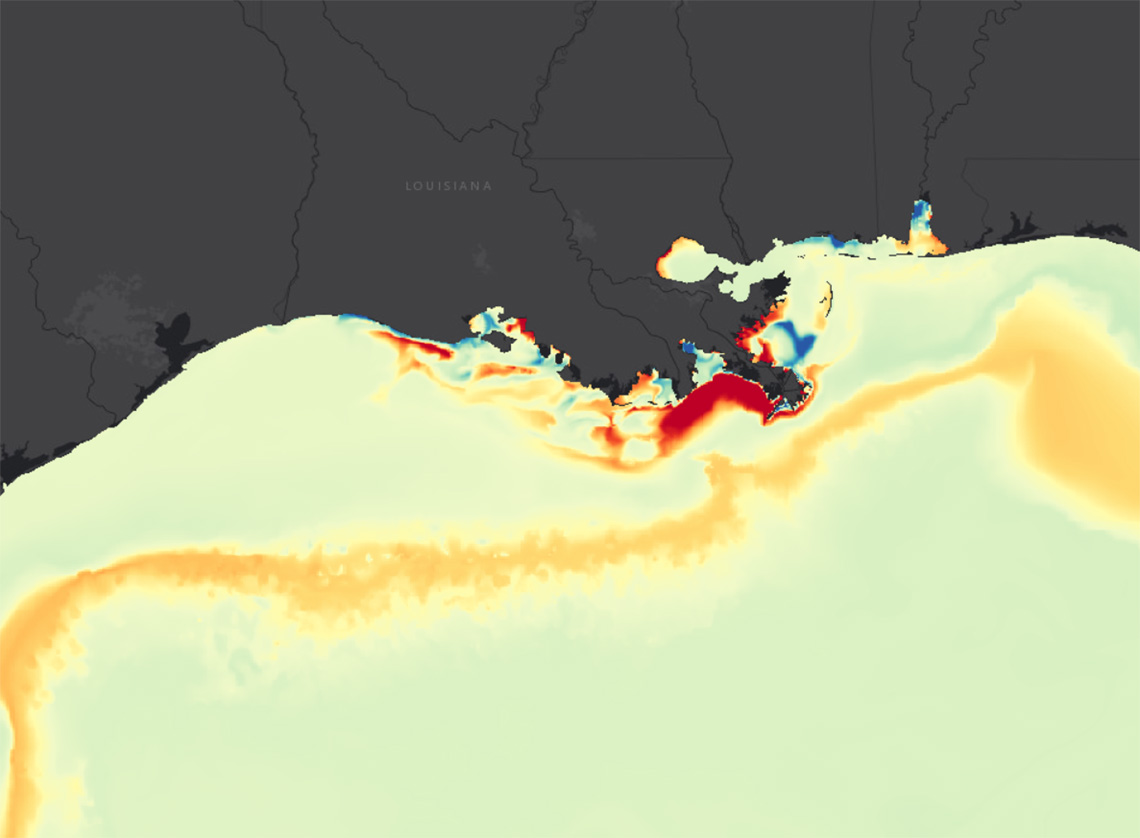
Now an LSU CC&E team is using it to better understand and predict one of the biggest issues in the northern Gulf – the hypoxic zone, a 4,000 square mile area of low to no oxygen. This yearly phenomenon, caused by runoff of excess nutrients, can kill fish and marine life.
Professor of Oceanography & Coastal Sciences Z. George Xue and Environmental Sciences Professor Supratik Mukhopadhyay and a team of experts that includes DOCS Post-doctoral Researcher Yanda Ou, have put together a new model that can be used to make daily hypoxia forecasts. Xue, Mukhopadhyay and Ou all hold joint appointments with the LSU Center for Computational Technology.
The new model can forecast daily hypoxic conditions within a 72-hour timeframe, and is lightweight enough to be run on a laptop. The team published their results in the journal Scientific Reports, part of the Nature family of journals.
“This breakthrough makes hypoxia forecasts faster, more accessible, and more actionable,” Xue said. “By cutting computation costs 100,000-fold, we can run real-time scenarios on everyday computers, giving managers and communities timely insights to prepare, respond, and adapt to the Gulf’s $82M-per-year hypoxia challenge. It also deepens our scientific understanding by allowing us to run large ensembles, test different conditions, and better capture the complexity of coastal systems.”
The forecast model was trained on a 14 – year hindcast of mechanistic, or numerical, models. Mukhopadhyay said this combination of artificial intelligence with mechanistic models makes a powerful tool. “AI can have a tremendous impact on advancing scientific research in multiple domains. Combining AI models with mechanistic models is essential for building AI system for science that are not only predictive but also transparent,” he said.
Accurate daily forecasts like those created by the model would allow researchers to better understand how organisms and food webs immediately respond to changes in hypoxic conditions, and in turn provide coastal managers with information needed to make critical decisions.
The model takes into account the complex set of forces at work during a hypoxic event – everything from the nutrient loads carried by river water to large-scale weather patterns and interactions with deep-ocean water. Testing of the model demonstrated that stratification of the water column plays an important role in making daily hypoxia predictions.
The paper also notes that, in order to reach the goals set by the Gulf Hypoxia Task Force, the model shows nutrient loads in the river will need to be reduced by more than 90 percent, which is higher than the goals set by the task force.
Xue said that while the use of artificial intelligence is transforming ocean forecasting. “High-efficiency AI models not only allow us to run large ensembles of forecasts—capturing a wider range of possible outcomes—but also make these tools accessible to a broader community beyond expert modelers. At the same time, traditional numerical models remain essential for providing the physical baseline conditions, and continued collection of high-quality observations is critical to train and validate AI systems,” he said.