

Stormwater Litter Management Project
About | Demonstration Sites | Litter Capture Devices
About the Project
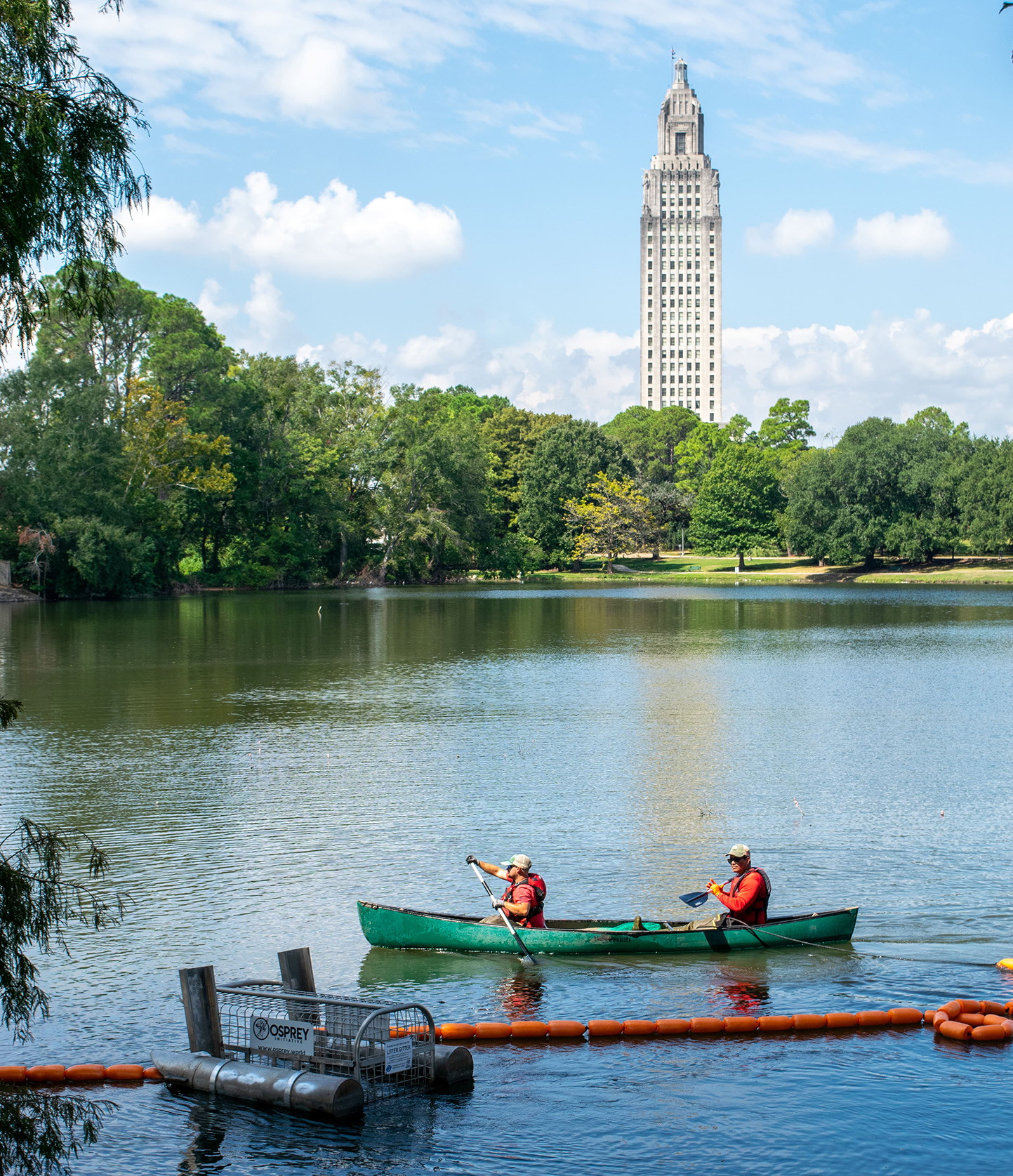
The LSU AgCenter Botanic Gardens, in collaboration with the Louisiana Stormwater Coalition, is advancing a long-term initiative to protect Louisiana’s wetlands through litter remediation and stormwater management. The program combines scientific research, strategic engineering, and community engagement to intercept aquatic trash before it reaches waterways. With professional services from the Osprey Initiative and Tricoeur Engineering Services, the team analyzes litter patterns to guide device placement and improve capture efficiency. These efforts serve to educate the public and empower local governments and businesses to reduce pollution at its source, fostering a cleaner, more resilient environment.
Funding
The Louisiana Stormwater Coalition led the passage of a legislative resolution that called for the Department of Environmental Quality, in collaboration with other entities, to explore funding options for preventing and remediating stormwater quality impairments (Resolution SLS 21RS-331). Grant funding was secured through the US Environmental Protection Agency (US EPA) Tash Free Waters Program grant, the Louisiana Department of Environmental Quality (LA DEQ) Clean Water State Revolving Fund, and with supplemental funding from the Louisiana Department of Culture, Recreation and Tourism (LA DCRT).
Objectives
A multi-pronged approach was implemented with the following objectives:
A) Reduce and prevent surface trash through engaging and empowering communities and businesses in the Scotlandville and Old South Baton Rouge communities,
B) Work with public entities to implement water filling stations and replacement of unsustainable products,
C) Implement four research and demonstration sites for data collection through the use of innovative trash-trap systems or plastic pollution prevention and collection technology and build public awareness of remediation of trash that does make its way into the watersheds.
The final objective is to use the information gathered from this work to develop the
‘Stormwater Litter Management Plan’ that can be distributed to municipalities statewide
describing tools, methods, and means removing the trash before it flows into watersheds.
Demonstation Sites
Capitol Lake
Much of the litter in Capitol Lake consists of single-use plastics, Styrofoam, and aluminum cans. As a bird sanctuary and a prominent location behind both the Louisiana State Capitol and the Governor’s Mansion, the lake's cleanliness is a top priority. Different types of litter catchment equipment was installed in 2025 to capture a majority of the litter flowing into the lake.
The Burden Wetlands
The LSU AgCenter Botanic Gardens at Burden is an expansive collection of specialty gardens, woodlands, wetlands, arboreta and university research facility located in the heart of Baton Rouge. The south side of the property is bordered by Ward Creek, which was channelized in the 1970s and now servs as the primary stormwater drainage channel for most of the city. The north side of the property is bordered by Interstate 10. At the northwest point of the property is a wetland and an abandoned borrow pit left from building the interstate. Stormwater flows into the borrow pit / wetlands during periods of heavy rain serving as a detention basin. Aquatic litter, associated with stormwater, collected in the borrow pit for over 30 years. A Litter Corral and Litter Booms were installed in 2023 to keep the wetlands litter free.
Bayou Fountain
For years, volunteers from PaddleBR and other locals have worked to keep Bayou Fountain—a scenic waterway along Highland Road—clean for paddlers. Building on their efforts, the Louisiana Stormwater Coalition selected the bayou as its first demonstration site in 2021, installing a 75-foot litter-catching boom to expand litter-free paddling to nearly 10 miles. Maintained by Osprey Initiative, the boom ensures proper litter removal and disposal.
Bayou Monte Sano
In July 2024, the Monte Sano Bayou in North Baton Rouge, one of the few bayous that flows directly into the Mississippi River, received a major cleanup through the “Bash the Trash” event. Over 50 volunteers from ExxonMobil, the LSC, the LSU AgCenter Botanic Gardens, and BREC removed hundreds of tires and nearly 700 pounds of litter. With ExxonMobil’s support, a litter-catching boom was later installed to prevent future pollution—showcasing the power of community partnerships in protecting local waterways and preventing plastic pollutions from entering a major river that flow into the Gulf.
Capture Device Types
Osprey Litter Corral
The Litter Corral includes two netted catchment fences that are installed where the primary sources of litter are not directly from a stormwater outfall but are aquatic or airborne concentrating in one area. There are two fences that can be shaped to the area of focus, the primary fence consists of a braced and anchored netting approximately 6 feet tall with tee post supports, a top tension line with soil anchors, and weighted bottom. A secondary fence can be installed that is taller and just beyond the primary fence to catch litter and debris that the primary fence does not collect.
Osprey Litter Boom
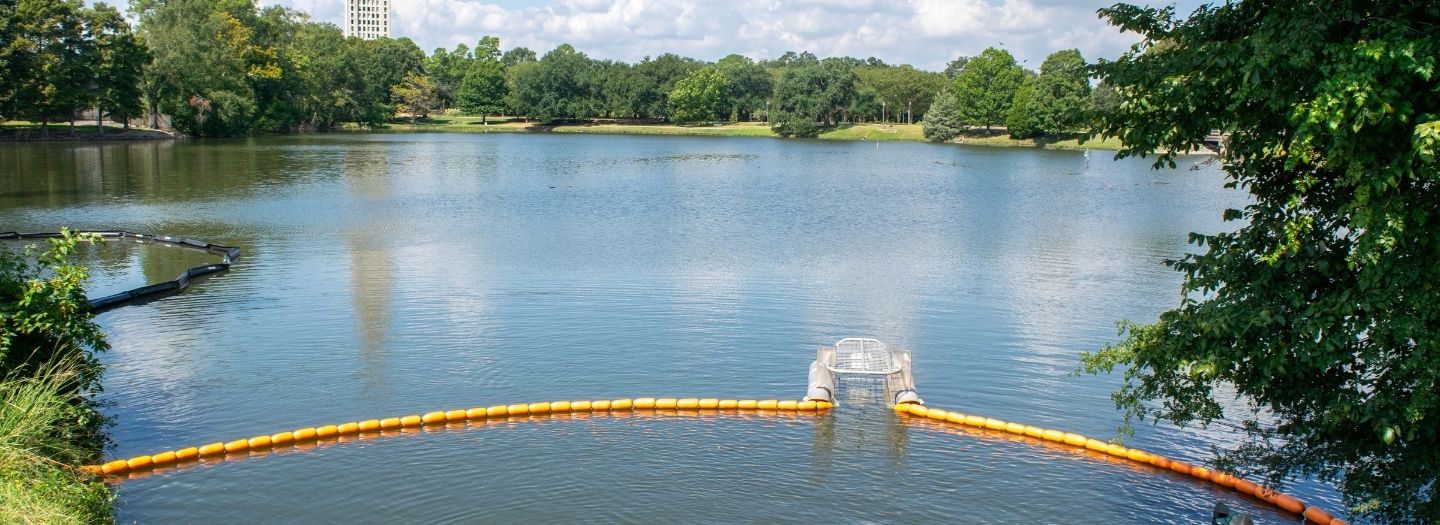
The Osprey Litter Boom is a floating barrier designed to tactically prevent litter from continuing to float downstream. The orange Turbulence Booms are positioned in front of the Litter Boom to slow the flow of water and for protection from large floating debris. Each boom comes in a wide variety of lengths, sizes, and a multitude of deployment options. These specialized booms can stretch across waterways or float along embankments to allow for optimal catchment. The booms are designed to create minimal impact on their surrounding environment and allow wildlife to easily navigate over or under the device.
Osprey Husky Boom
The Osprey Husky Boom is similar to the Osprey Litter Boom, its primary function is to prevent litter from continuing downstream. In this application, the boom keeps debris and litter from entering the pump station. The key difference is that the Husky Boom is constructed from a more rigid material, allowing it to maintain its shape during high-flow events.Osprey Litter Gitter
The Osprey Litter Gitter is a floating aluminum structure that uses booms to direct the flow of water and litter into a trap. These floating collection devices collect both litter and debris with the goal of preventing it from going farther downstream. The booms allow wildlife, kayaks, and boats to navigate over or under, to create a minimal impact on the surrounding environment.
Storm Drain Collection Devices
LittaTrap™
The LittaTrap™ is an innovative catch basin inlet filter (insert) device designed to be easily installed into new and existing stormwater catch basins of any size or configuration. The Enviropod® LittaTrap™ can be installed in grate (drop) inlets, curb inlets, combination grate/ curb inlets, or round manhole catch basins.
FloGard®
The FloGard® is a catch basin insert that provides physical screening of litter and debris using a filter fabric basket. It is ideally suited for removal of primary pollutants from paved surfaces in commercial and residential areas.
Osprey Litter Interceptor
The Osprey Litter Interceptors are a customizable stormwater inlet protection device that is individually fit for any inlet. The device intercepts litter greater than 2 inches in diameter, while also designed to allow vegetative debris to pass through.