
Roxanne Dill, 2026 C-I Teaching & Service Excellence Award recipient
April 20, 2026
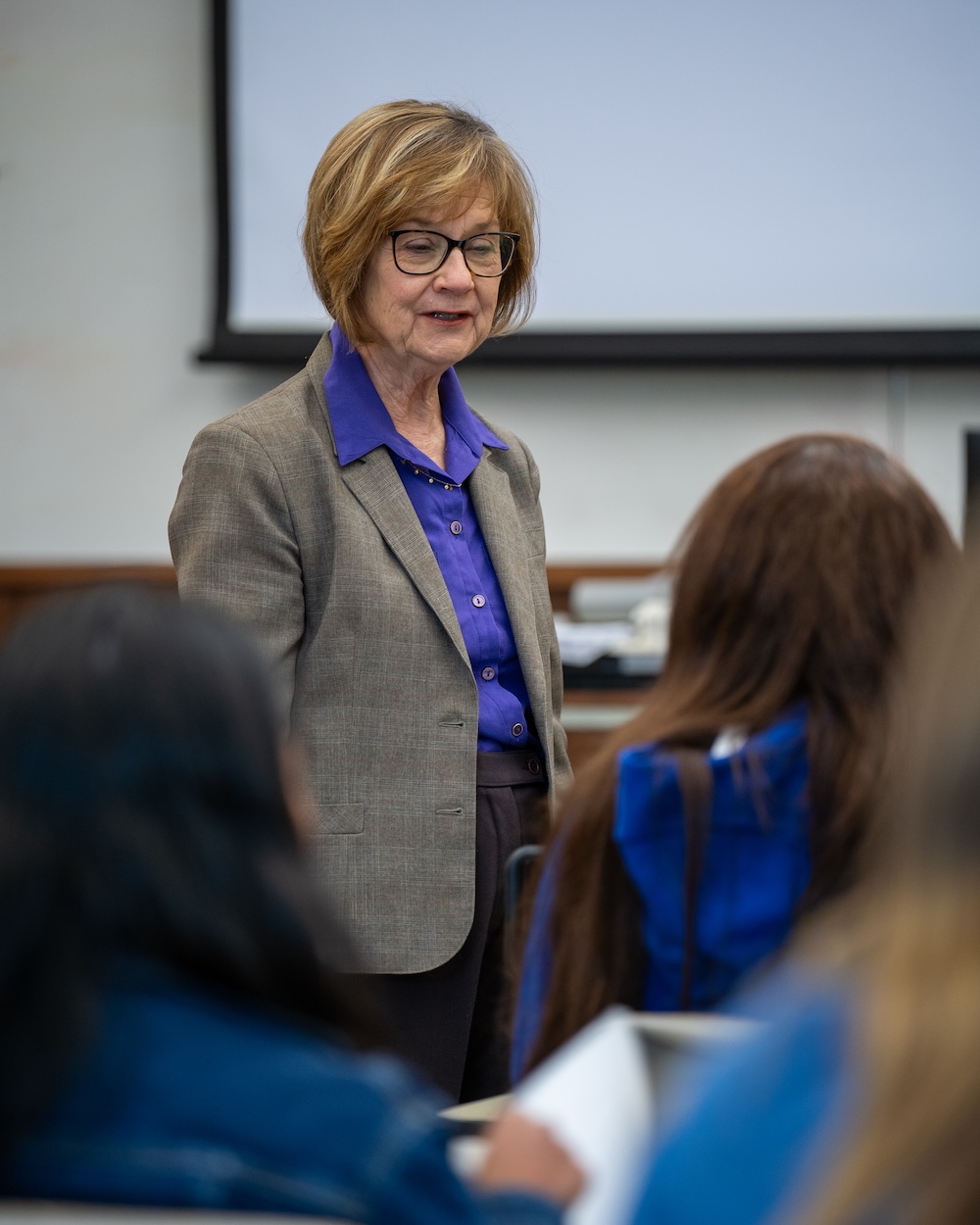
– Credit: Manship School of Mass Communication
For Roxanne Dill, teaching mass communication has never been just about the craft of writing—it's about preparing students to communicate with confidence in a world that keeps changing the rules. As Senior Instructor and Journalism Area Head in the Manship School of Mass Communication, Roxanne has spent more than a decade making that preparation both rigorous and genuinely fun.
Roxanne registered her first Communication-Intensive section with CxC in 2012, and the work has only expanded from there. Over 113 sections across six courses—including Media Writing, Honors Media Writing, Introduction to Mass Media, and Advanced Journalism—she has certified courses across written, visual, and spoken communication modes. Her students don't just read about journalism; they interview family members about defining historical moments, shoot and edit original photography using principles like rule of thirds and focal point, pitch feature stories to their peers, and build digital portfolios ready for the job market before they graduate.
One of her signature tools is the AP Style Smackdown, a gamified quiz that turns the notoriously dry conventions of Associated Press writing style into a competitive classroom event. The same instinct drives her broader teaching philosophy: skills stick when students actually use them, and students use them more willingly when the experience doesn't feel like a chore. Her AP style and grammar study guides—developed and updated since 2013—are now used by every faculty member in the Manship School, distributed to students across all concentrations and course levels.
That reach beyond her own classroom is precisely what distinguishes Roxanne's contribution. As journalism area head, she coordinates approximately 10 media writing sections each semester, mentoring both full-time faculty and adjunct instructors on lesson planning, technology, and communication-focused pedagogy. Sadie Wilks, Associate Dean of Undergraduate Programs and Student Success, puts it directly: "She teaches communication-intensive courses herself and actively assists other faculty in developing and refining C-I courses, making her a key driver of communication-centered learning across the program."
Roxanne's influence extends into students' lives well beyond the classroom. As rector of the Mass Communication Residential College, she works with first- and second-year students during the most demanding transition of their academic lives—and has used that proximity to build a special section of Introduction to Mass Media designed specifically for residential college students, weaving C-I projects into a course that also builds community. Student Rami Burks describes the cumulative effect of her teaching: "Her focus on communication in the classroom allows her students to feel more confident in their communication abilities, and it makes the transition from lower-level to upper-level mass communication classes easier."
That confidence is measurable. Roxanne has mentored three Distinguished Communicator candidates, and her anecdotal evidence from C-I projects tells a consistent story: students who practice communication skills in a structured, low-stakes environment carry those skills into internships, Student Media, and independent projects they launch on their own. Her participation in the CxC Faculty Summer Institute in 2019 deepened her understanding of how the C-I framework could sharpen what she was already doing intuitively.
For Roxanne, the case for communication in mass communication is obvious—but she's learned not to take it for granted. "I didn't understand the value proposition that CxC brought to my courses," she has said of her early skepticism. "Introducing the communication-intensive modes into my mass communication classes enhanced student learning and helped students practice skills that are necessary for post-graduation success." It's a candid admission from someone who has since made those skills the throughline of an entire program's writing instruction—and who still finds ways to make students want to show up and try.
About the C-I Teaching & Service Excellence Award
The C-I Teaching & Service Excellence Award (formerly the Outstanding CxC Faculty Award) recognizes an individual who, through teaching, research, faculty teaching development, or CxC program efforts, engages and champions C-I pedagogy across campus in an exemplary manner. Any LSU faculty member—tenured, tenure-track, or non-tenure track, full or part-time—actively engaged in the CxC program and C-I teaching and learning, and who has not previously received this award, is eligible. Recipients receive a $1,500 award.