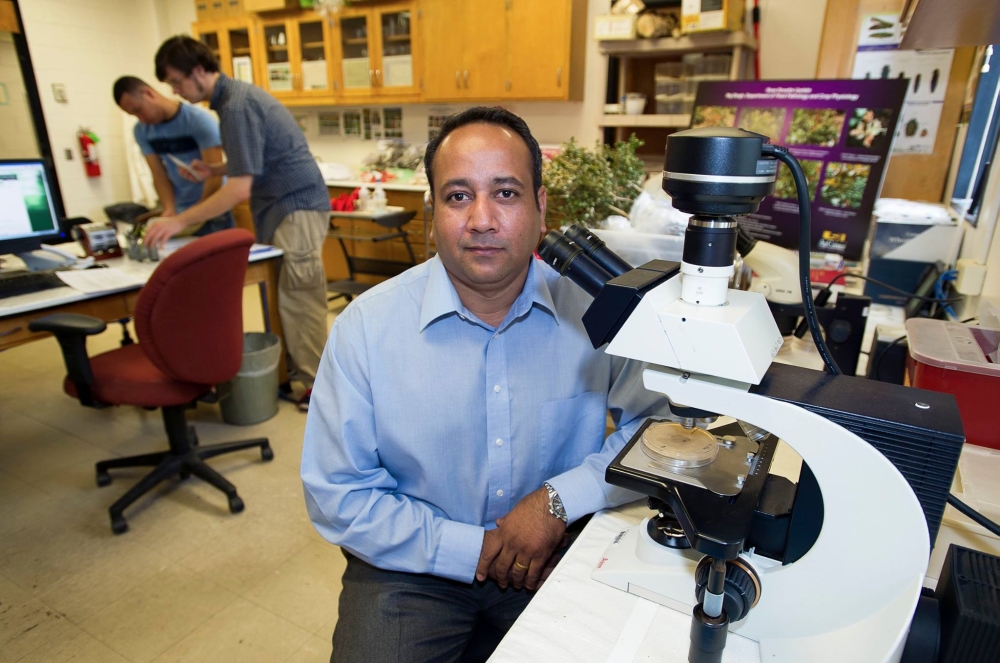
|
Mala
Ganiger
Graduate Student
E-mail:
mganiger@agcenter.lsu.edu
Major Professor:
Dr.
Zhiyuan Chen
EDUCATION
-
2009 - Present: Graduate Research
Assistant, Dept. of Plant Pathology and Crop
Physiology, Louisiana State University
-
2004 - 2007: M.Sc. (Agricultural
Biotechnology), University of Agricultural
Sciences, Dharwad, Karnataka, India
-
2000 - 2004: B.Sc. (Agriculture),
University of Agricultural Sciences, Dharwad,
Karnataka, India
RESEARCH EXPERIENCE
-
Nov 2008 - July 2009: Research
Associate, Cotton Agriculture Research Station,
Dharwad, Karnataka, India
-
Feb - Nov 2008: Senior Research
Fellow, Cotton Agriculture Research Station,
Dharwad, Karnataka, India
-
Mar - Aug 2007: Technical
Research Assistant, Institute of Agricultural
Biotechnology, Dharwad, Karnataka, India
RESEARCH FOCUS
Asian soybean rust (ASR) caused by Phakopsora
pachyrhizi was first observed in Japan 1902, and
has since spread throughout the world. In recent
years, ASR was reported in Africa and South America
and is rapidly spreading since. In November 2004,
for the first time P. pachyrhizi was reported
in Louisiana and soon thereafter in other
southeastern U.S. states. The threat of widespread
infections of soybean by P. pachyrhizi has
increased in the past few years due to its ability
of over wintering on a number of alternative hosts
including kudzu, causing potential high inoculums
accumulation in the early spring and due to the lack
of resistant commercial varieties. It has been
reported that P. pachyrhizi infection can
cause quick defoliation and severe yield losses up
to 80%.
So
far, a few soybean lines have been identified
showing resistance against specific isolates of
P. pachyrhizi collected internationally and in
USA. However, the resistance of these lines is not
durable and is overcome by the virulent ASR
isolates. At present the disease is controlled
mainly through the timely and costly fungicide
applications. Therefore, to overcome the menace of
ASR, there is a critical need of novel sources of
resistance.
In
our lab, I am using Proteomics based approach to
examine host-pathogen interactions at the molecular
level to identify host and fungal proteins induced
during compatible and incompatible interactions.
Soybean Near isogenic lines (NILs) with different
resistance levels to ASR are being used and
identified proteins will be characterized using VIGS
(Virus Induced Gene Silencing) to understand their
role in host-pathogen interactions.
PUBLICATIONS IN PEER-REVIEWED
JOURNALS
-
Ganiger, M. C.,
Bhat, S., Chettri, P., and Kuruvinashetti, M. S.
2009. Production of endoglucanase by
Trichoderma for Control of Phytopathogenic
Fungus Sclerotium rolfsii. Journal of Applied
Sciences Research 5(7): 870-875.
-
Ganiger, M. C.,
Bhat, S., Chettri, P., and Kuruvinashetti, M. S.
2008. Cloning and expression of Endoglucanase
Genes from Trichoderma species in
Saccharomyces cerevisiae. Journal of
Applied Sciences Research 4(11): 1546-1556.
BOOK CHAPTERS
Chettri, P., Ganiger, M. C.,
and Krishnaraj, P. U. 2010. Trichoderma:
Biology and its Potential for Biocontrol. In
Molecular Biology of Plant Pathogens.
Gangawane, L.V. and Khilare, V. C. eds. p 40-57. Daya Publishing House,
India.
POSTER PRESENTATIONS
-
Ganiger, M. C.,
Walker, D. R., and Chen, Z. 2011. Differences in
responses and protein profiles of soybean near
isogenic lines (NILs) to Phakopsora
pachyrhizi inoculation. Phytopathology
101: S58.
-
PARK, S., Chen. Z, Ganiger, M.
C., and Fortunato, A. A. 2010. Protein
profile differences between soybean accessions
resistant and susceptible to soybean rust (Phakopsora
pachyrhizi). Phytopathology 100: S96.
-
Ganiger, M. C.,
Bhat, S., and Kuruvinashetti, M. S. 2007.
Cloning and Expression of Endoglucanase Genes
from Trichoderma spp. in Saccharomyces
cerevisiae. Karnataka journal of Agricultural
sciences 20(4): 960.
|