|
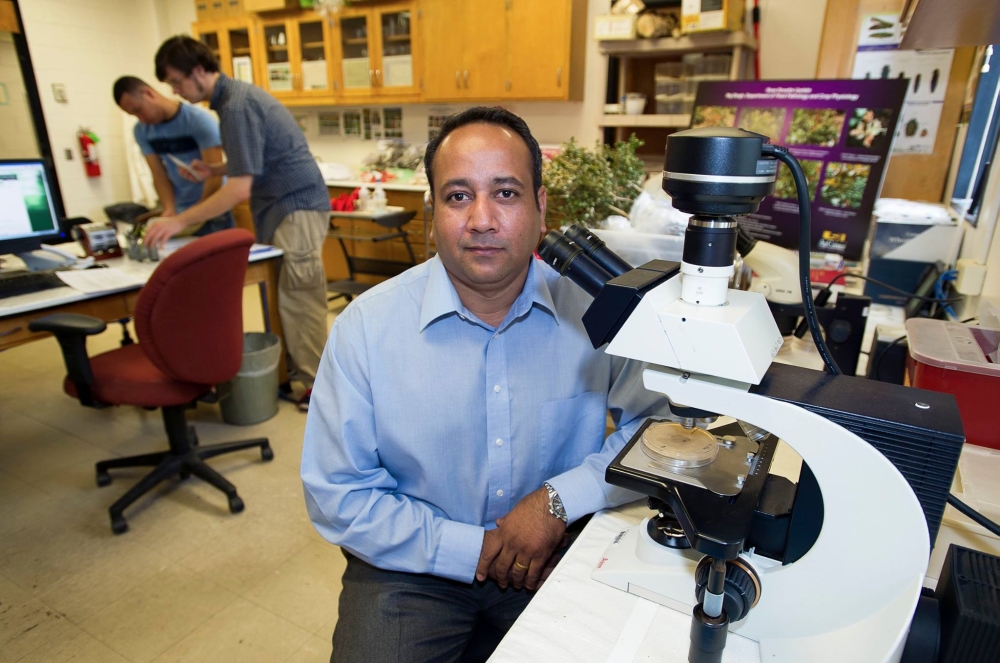
Ruoxi
Chen
Graduate Student
E-mail:
RChen@agcenter.lsu.edu
Major Professor:
Dr. Jong
Hyun Ham
Education:
-
2008-Present - PhD
Candidate in Plant Pathology (enrolled).
Louisiana State University, Baton Rouge,
Louisiana 70803
-
2004-2008 - B.S.
Plant Protection. Shandong Agricultural
University, Taian, Shandong 271018
-
1996-2001 -
Shandong Heze No.1 Middle School,
Heze,
Shandong 274000
Work Experience:
2008-Present -
Research Assistant. Louisiana State University,
Department of Plant Pathology
Awards and
Recognition:
-
2006 Academic
Outstanding Student Prize
-
1st
semester: College third-class scholarship
-
2nd
semester: College third-class scholarship
-
3rd
semester: College second-class scholarship
-
4th
semester: College first-class scholarship
-
5th
semester: College second-class scholarship
-
6th
semester: College second-class scholarship
Publications:
Isolation of Antagonistic Bacillus
B102 Against Brown-Spot Disease of Tobacco and
Determination of The Antifugal Activity. LI Anna,
JIN Ying, LU Peng, ZHENG Yuanyuan, CHEN Ruoxi, DING
Aiyun. Department of Plant Protection, Shandong
Agricultural University, Taian, Shandong, P. R.
China. Published in Tobacco Science & Technology,
2008 NO.2, (ISSN 1002-0861) CN41-1137/TS
Extracurricular
Activities:
-
Active member of
Young Volunteers Association; 2004-2005
-
Active member of
Reading and Debating club; 2004-2005
-
Secretary of
University student autonomy committee; 2004-2005
-
Vice-monitor of
silk science class 04-2; 2004-2005
-
Attended American
Phytopathological Society Meeting. 2010.
Charlotte, North Carolina
-
Presented at APS
Southern Division Meeting. 2011. Corpus Christi,
Texas
Current Research:
Burkholderia glumae
is the major causal agent of an economically
important rice disease Bacterial panicle blight
(BPB). The known virulent factors of B. glumae,
toxoflavin, fagella, lipase and catalase
share a LuxI/LuxR-type quorum sensing system as
their regulator. tofI and tofR genes
encode the N-acyl homoserine lactone (AHL) synthase
for the B. glumae quorum sensing signals,
N-octanoyl homoserine lactone (C8-HSL) and N-hexanoyl
homoserine lactone (C6-HSL), and the receptor for
C8-HSL, respectively. Even though B. glumae
produces both C6-HSL and C8-HSL, the function of
C6-HSL is still unknown. According to sequence
information from the National Center of
Biotechnology Information (NCBI), there are at least
six putative LuxR homologs in the entire genome of
the B. glumae strain BGR1, but they are not
coupled with LuxI homologs. Therefore, C6-HSL may
involve in the regulatory network through other LuxR-family
proteins other than TofR. In our study, B. glumae
genes dependent on different autoinducers and
regulators of the B. glumae quorum sensing
system were sought using various techniques of
molecular genetics and genomics. Though this study,
we expect that the quorum-sensing network for
regulating the virulence of B. glumae would
be better understood.
|