|
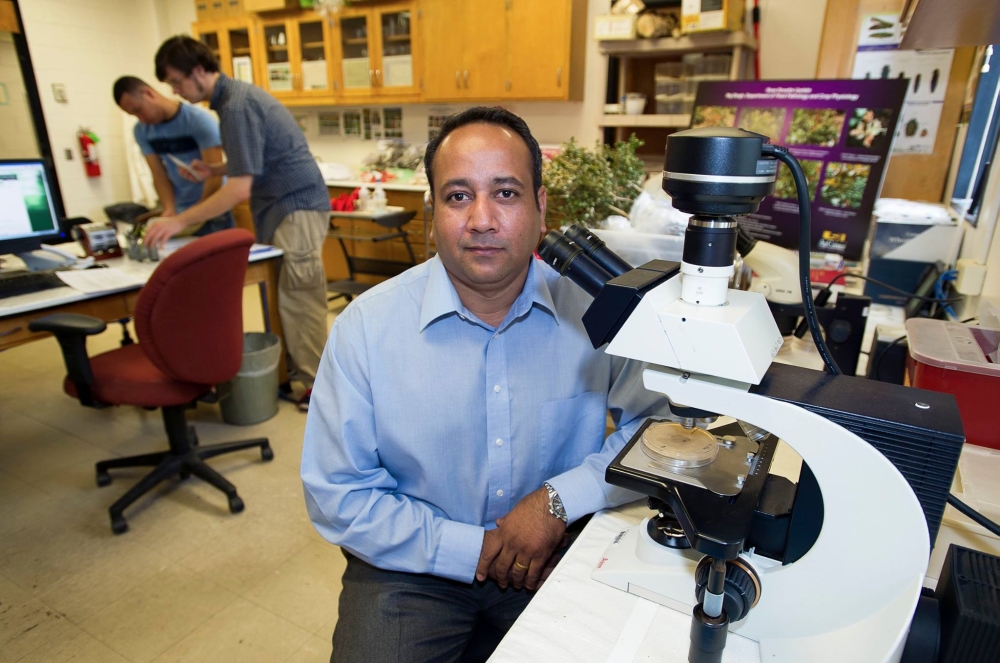
Raymond
W. Schneider
Professor
Recent findings from this latter thrust are extremely
intriguing and potentially useful for managing this
recalcitrant disease. Briefly, Schneider’s group (Brian
Ward, Clark Robertson and Eduardo Chagas) found that the
toxin produced by the pathogen may be involved in iron
sequestration within the leaf, which would be similar to the
function of siderophores (biological iron chelators) in
bacteria. This chelated iron would then be available to the
fungus during its endophytic colonization phase (see
below). Given that biological chelators are induced by low
iron concentrations, Schneider’s group postulated that if
iron was made available to the pathogen, production of the
chelator (toxin) would be inhibited, and the pathogen would
lose its pathogenicity factor. Results from in vitro
and field studies confirmed this hypothesis, and a very high
level of disease control was observed in field experiments
in which iron was applied as a foliar spray. These results
must be confirmed, but clearly a new paradigm in disease
management and host:pathogen interactions has been opened.
One of Schneider’s most recent accomplishments is the
discovery that C. kikuchii infects plants many weeks
before the appearance of symptoms of Cercospora leaf blight
- the so-called latent infection phase of disease
progression. This research involved the development of a
real-time PCR protocol by a graduate student (Ashok Chanda)
and its use in monitoring infection in the field. This novel
combination of molecular protocols and practical field
pathology resulted in the targeted development of a disease
control strategy in which the fungicide is applied once
during the season long before symptoms occur in order to
suppress latent infection. This technological achievement
is now being evaluated in commercial fields, and reports
from crop consultants are very encouraging. Such a
multi-year project exemplifies the classic experiment
station mission of conducting fundamental research on an
applied problem.
Schneider’s group (Monica Lear, Karol Elias and Michelle
Warr) described for the first time the roles of root
colonization by nonpathogenic strains of F. oxysporum
(endophytes) and their role in disease suppressive soils.
He showed that roots that had been colonized by endophytic
strains of F. oxysporum were either protected from
infection by the pathogen or they were predisposed to
infection. Schneider’s publications in this area led to
work by others in which they showed that Fusarium wilt of
watermelon and other crops could be managed by inoculating
plants with effective competitive endophytic strains. More
recent molecular work by an undergraduate student in
Schneider’s lab showed that these strains were virtually
indistinguishable from pathogenic strains of F. oxysporum,
which suggests that pathogenic strains evolved from these
endophytes. This work could lead to novel means of cultural
disease control by stimulating higher populations of these
beneficial strains in order to manipulate soils to become
disease suppressive.
In other research projects, Schneider showed that chloride
in association with certain cation ratios suppressed root
infection by F. oxysporum. The mechanism of disease
suppression was related to root osmotic regulation and root
exudation. This work also stimulated research by others and
opened new fields of discovery. Schneider’s group (Nicole
Ward, Brian Ward and Clark Robertson) recently returned to
this line of investigation, and they showed that certain
minor elements, including iron and aluminum, suppressed
infection of soybean by the Cercospora leaf blight
pathogen. This discovery holds great promise for managing
this recalcitrant disease. Disease suppression apparently
is not related optimizing plant nutrition in that minor
element tissue analyses are within sufficient ranges.
Rather it appears that there is a direct effect on the
pathogen possibly related to control of toxin production
within leaf tissue. Elucidating the mechanisms involved in
disease suppression by these minor elements may lead to
entirely new approaches to managing troublesome foliar
diseases of many crop species.
Other research projects published by Schneider’s group (Pali
Kuruppu) involved providing an explanation for cultural
control of red crown rot in soybean by delayed planting.
Also, he and a graduate student (Guoping Su) showed that the
charcoal rot pathogen adapts to rotation crop sequences, and
this provides a partial explanation of why certain crop
rotation sequences are superior in managing this disease,
which can be very damaging during moderate to severe drought
conditions.
In recent years Schneider’s professional life has been
dominated by soybean rust, which he discovered for the first
time in North America in 2004.
The discovery and associated excitement were described in
Science magazine by their reporter (Science,
3 December 2004. 306:1672-1673).
Schneider and his group (Nicole Ward, Clark Robertson, Paul
Mumma and others) immediately began evaluating numerous
fungicide chemistries for efficacy, and his work and that of
his colleagues in Louisiana and other states on rates and
times of application provided the soybean industry with an
arsenal for combating this potentially devastating disease.
With this disease, too, molecular tools were used to
demonstrate that there is an extended latent phase, and
fungicide efficacy was greatly improved by spraying long
before the development of disease symptoms (Nicole Ward,
Clark Robertson). Other research on soybean rust involved
the development of risk models, spatial analyses (GIS) of
disease development, and other pursuits.
Schneider, a graduate student (Tomas Rush) and collaborators
(Dr. Cathie Aime and others) determined that the currently
used primers and probe that are used in real-time PCR
detection technologies for the soybean rust pathogen (Phakopsora
pachyrhizi) also detect other Phakopsora
species. This finding explains why the rust pathogen was
claimed to have been found throughout the eastern U.S. and
Canada. These questionable findings were used by others to
develop pathogen dispersion models and caused widespread
concern about the spread of the disease into the Midwest and
Ohio River Valley. Conclusions from this work showed that
these models must now be re-evaluated, and the United
Soybean Board recently provided funding to conduct this
investigation.
Another project was nationwide in scope in which Schneider
and his group participated in a spore dispersal study.
Schneider soon realized that current spore trapping
technology was not adequate for monitoring airborne
populations of the soybean rust pathogen. Schneider and an
undergraduate student (Erik Durr) from Biological and
Agricultural Engineering designed and tested an
electrostatic particulate sampler that was far more
efficient and versatile in quantifying spore populations in
the atmosphere. This device was recently awarded a patent
(held by the LSU AgCenter), and a company was formed to
produce and market this device under the auspices of the LSU
Business and Technology Center. The grape industry in
California is currently testing this technology for
management of powdery mildew, which is the most serious
disease affecting grapevine worldwide.
A graduate student in Schneider’s program (Nicole Ward)
discovered that a unique fungus, Simplicillium
lanosoniveum, parasitized rust spores as its exclusive
food source. The fungus was found only in association with
soybean rust pustules. She went on to show that the fungus
could be grown in culture and that it could be formulated as
a biological control agent that was equivalent in efficacy
to the most commonly used fungicide. This fungus is now
being
evaluated for commercial use by Marrone Bio Innovations,
Inc.
Other achievements are briefly described below:
Collaborated with Dr. David Walker, soybean geneticist at
University of Illinois, in establishing a soybean rust
disease nursery in Baton Rouge to screen for disease
resistance.
In collaboration with Dr. Boyd Padgett, Dr. Pat Bollich and
Dr. Kurt Guidry following 6 years of field experiments in
several locations, developed a yield loss calculator for
three soybean diseases. To be used as a decision aid by
producers in deciding whether or not to apply fungicides.
In collaboration with several other LSU AgCenter scientists
in several years of field experiments, showed that the
soybean green stem disorder is related to the use of
strobilurin fungicides and that there is a genetic component
to this disorder.
Other achievements:
In collaboration with Dr. Jeff Hoy and postdoctoral
researcher Dr. Weidong Chen, established genetic
relationships among several Pythium species that
infect sugarcane and rice and showed that certain Pythium
species are responsible for stubble decline in sugarcane.
Determined that several Pythium species infect feeder
roots of rice and coined the disease name feeder root
necrosis. Control of this disease with soil
applications of metalaxyl resulted in significant
enhancement of seedling establishment, early season growth
and yield.
With graduate students Susan Useman and Clark Robertson and
collaborators Dr. Wade Elmer and Dr. Irv Mendelssohn,
provided experimental evidence that showed that the
extensive dieback of Spartina alerniflora was caused
by weakly pathogenic, endophytic strains of Fusarium
proliferatum and other Fusarium species following
predisposition by water stress. This plant is the
predominant species in coastal salt water marshes along the
Gulf Coast and Atlantic Seaboard where the dieback also was
documented.
Dr. Schneider has published 76 refereed journal articles,
edited one book, 11 book chapters, numerous popular press
articles (including Louisiana Agriculture), and more
than 100 abstracts.
Teaching Experience
PLHL 4000 General Plant Pathology
PLHL 7082 Soilborne Plant Pathogens
PLHL 4014 Diseases of Economic Crops (Section of soybean
diseases)
[previous page]
|