|
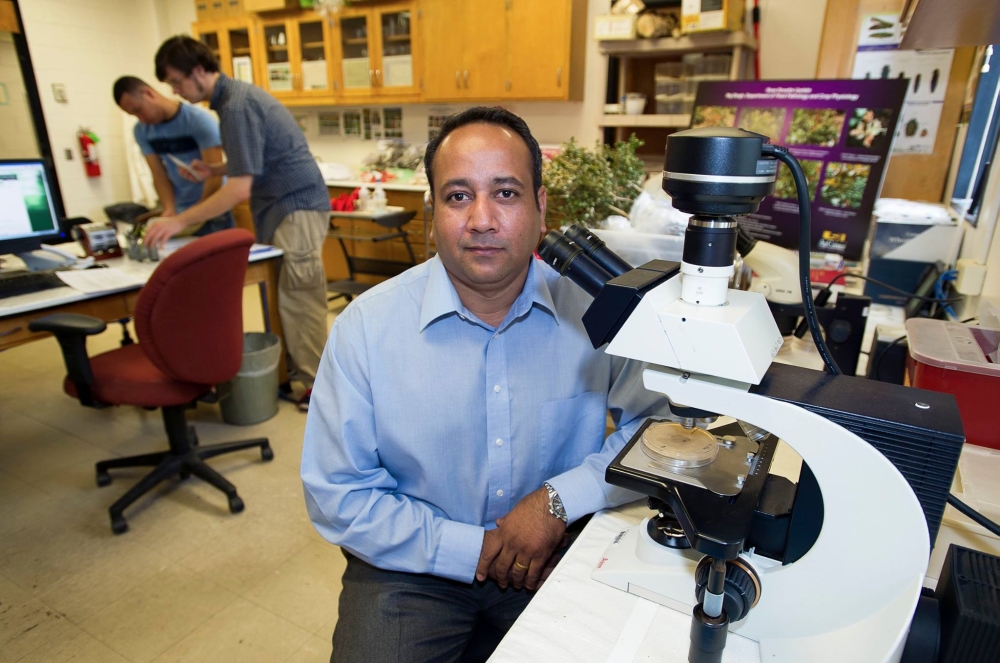
Raymond
W. Schneider
Professor
302 Life Sciences Bldg.
Address 2: Baton Rouge, LA 70803
Phone: (225) 578-4880
Fax: (225) 578-1415
E-mail:
RSchneider@agcenter.lsu.edu
Education/Training
-
B.S. in Biology/Chemistry, University of Alabama - 1969
-
M.S. in Plant Pathology, University of Illinois - 1971
-
Ph.D. in Plant Pathology, University of Illinois - 1973
Professional Experience
-
Graduate Research Assistant (with J. B. Sinclair),
Department of Plant Pathology, University of Illinois.
September 1969 - April 1973.
-
Ford Foundation Research Fellow (with R. J. Williams),
International Institute of Tropical Agriculture, Ibadan,
Nigeria. January 1972 - January 1973.
-
Postdoctoral Research Plant Pathologist (with R. G.
Grogan), Department of Plant Pathology, University of
California, Davis. May 1973 - April 1976.
-
Assistant Professor,
Department of Plant Pathology, University of California,
Berkeley. April 1976 - June 1984.
-
Department of Plant
Pathology and Crop Physiology, Louisiana State
University
-
Assistant Professor, July 1984 - June 1986
-
Associate Professor,
July 1986 - June 1991
-
Professor, July 1991 -
present
-
Sabbatical leave with
Dr. David Weaver, Department of Agronomy, Auburn
University. Soybean geneticist/breeder. Summer 2000.
Areas of Specialization/Research
Dr. Schneider is indebted to his research associates,
graduate and undergraduate students, postdoctoral
researchers, visiting scientists, colleagues and
collaborators who have contributed their creative energies
and hard work to his research program. He was honored to
receive the Tipton Team Research Award twice in recent
years.
His research program is centered primarily on soybean pathology
with responsibility to provide short- and long-term disease
control strategies for this important crop. Several diseases
and control strategies and tactics are currently being
investigated. Most
of Dr. Schneider’s research career has involved conducting
fundamental research on applied problems with the ultimate
goals of explaining disease occurrences and discovering
solutions for recalcitrant disease situations in several
crop species. These mission-oriented research projects have
led to significant advances in our understanding of
host:pathogen physiology and genetics as well as new
strategies and tactics in cultural, chemical and biological
control of plant diseases. Below are brief summaries of
some of these accomplishments. Publications related to
these topics can be found in Dr. Schneider’s curriculum
vita.
Cercospora leaf blight of soybean, caused by Cercospora kikuchii,
has been a minor disease, but in recent years it has become
the most important disease in the state. Current research
programs include evaluation of fungicides and times and
rates of application for optimal disease control. A more
basic thrust utilizes molecular techniques to examine
phylogenetic relationships within the genus and to assess
genetic diversity in populations of the pathogen in order to
determine if new races or biotypes are arising. Other
studies include the effects foliar applications of specific
minor elements on infection and disease development. This
project has yielded unexpected levels of disease control
especially with iron applications. Fundamental projects are
currently in progress to determine the mechanism(s) involved
with these effects.
Schneider’s group (Karol Elias, Monica Lear, Guohong Cai,
James Correll, John Puhalla and others) was instrumental in
the discovery, description and probable roles of vegetative
compatibility groups (VCG’s) in Fusarium oxysporum
and Cercospora kikuchii. These studies were later
augmented by molecular analyses. Briefly, by using specific
mutants, he and his students and colleagues showed that
these two important fungal pathogens undergo hyphal fusions
and that genetic information is exchanged by this mechanism
(parasexual recombination). They went on to document that
there is very little genetic diversity within VCG’s in F.
oxysporum and that there are very few VCG’s within
formae speciales of this species. These findings led to the
conclusion that pathotypes (races) arise very slowly
(approximately every 30 years) in this important pathogen,
and breeding for disease resistant to new races offers a
viable means of disease management. In a very intensive
study, he and his students and collaborators went on to show
that new races arose from the existing population via
mutation and selection rather than by genetic
recombination. On the other hand, his group showed that
there is a large assortment of VCG’s in C. kikuchii,
the soybean leaf blight pathogen, and genetic diversity
among VCG’s is very extensive, which suggests that genetic
recombination occurs in nature and that there is probably an
extant sexual stage. These findings explained why formerly
resistant soybean varieties succumbed to the disease within
a few years and why resistance in the pathogen to commonly
used fungicides appears to be increasing at a rapid pace.
Schneider was recently awarded a grant from the United
Soybean Board to investigate the genetic basis for this
extreme level of genetic diversity and to determine the
probable limits for the development of new pathotypes.
Given the extreme genetic plasticity of this pathogen, it is
apparent that we must develop and evaluate novel means to
manage Cercospora leaf blight in soybean. It is for this
reason that Schneider’s group is now heavily involved with
exploring disease suppression with certain micronutrients,
e.g. iron and aluminum.
[more]
Publications |
Curriculum Vitae
|