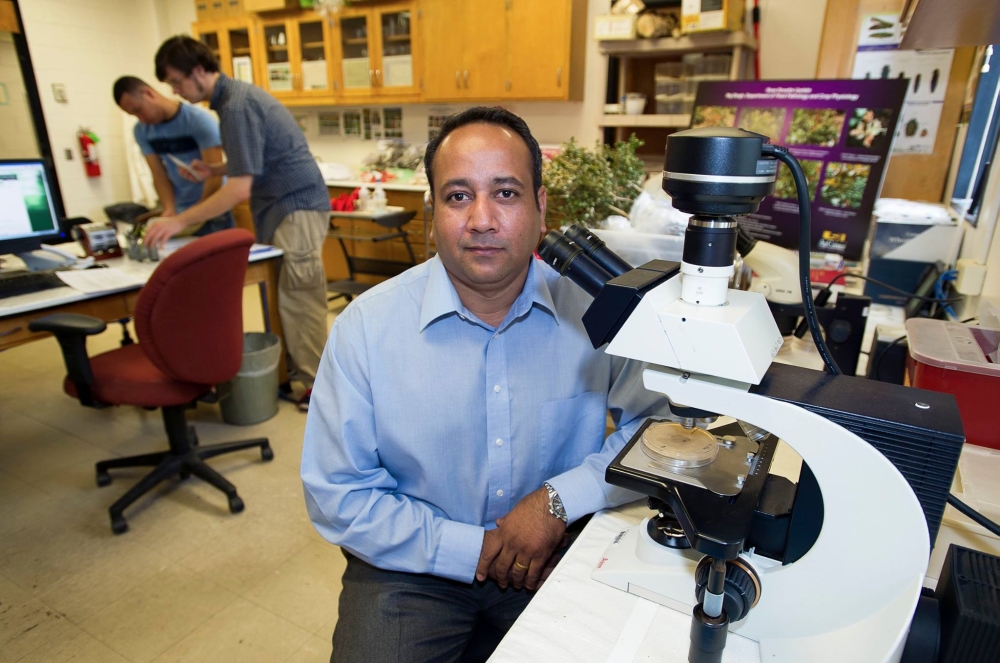
|
Marc A. Cohn
Professor
Publications/Presentations/Patents
Refereed Journal Articles
Chappell, J., F. D. Gatz, and M. A. Cohn. 2006 . A viability
test for Spartina alterniflora. Seed Science & Technology
(in preparation).
Chappell J., M.A. Cohn. Seed recalcitrance in Spartina
alterniflora. I. Re-evaluation of the role of lipid
oxidation in death by drying (in preparation)
Johnson, D., D. R. Gossett, S. W. Banks and M. A. Cohn. 2006
. Seed dormancy in red rice. Changes in GSH, GSSG, cysteine,
and cystine during dry afterripening. Seed Science Research
(in preparation).
Gianinetti, A. and M. A. Cohn. 2006 . Seed dormancy in red
rice. Interaction of dry afterripening and incubation
temperature. Seed Science Research (accepted).
Gianinetti, A. and M. A. Cohn. 2006 . Seed dormancy in red
rice. Population-based analysis of afterripening with a
hydrotime model. Seed Science Research ( accepted).
Cohn, M. A. 2006 . Dormancy: an overview. pp. xxx-xxx in
Black, M.; Bewley, J. D.; Halmer, P. (Eds) Encyclopedia of
seeds. Science, Technology and Uses. Wallingford, CABI
Publishing (in press).
Kucera, B., M.A. Cohn, G. Leubner Metzger. 2005. Plant
hormone interactions during seed dormancy release and
germination (Invited Review) Seed Science Research 15:
281-307.
Cohn, M. A. 2002. Seed dormancy in red rice. A balance of
logic and luck. Weed Science 50:261 - 266.
Footitt, S. and M. A. Cohn. 2001. Developmental arrest: from
sea urchins to seeds. Seed Science Research 11:3 - 16.
Doherty, L. C. and M. A. Cohn. 2000. Seed dormancy in red
rice (Oryza sativa). XI. Commercial liquid smoke elicits
germination. Seed Science Research 10: 415 - 421.
Oard, J.; M. A. Cohn; S. Linscombe; D. Gealy; K. Gravois.
2000. Field evaluation of seed production, shattering and
dormancy in hybrid populations of transgenic rice (Oryza
sativa) and the weed, red rice (Oryza sativa). Plant Science
157: 13 - 22.
Cohn, M. A. and H. W. M. Hilhorst. 2000. Alcohols that break
seed dormancy: the anesthetic hypothesis, dead or alive? in
J.D.Viemont and J.Crabbe (eds) Dormancy in Plants: From
Whole Plant Behaviour to Cellular Control. CAB Publishing,
Wallingford. pp 259 - 274.
Hilhorst, H. W. M. and M. A. Cohn. 2000. Are cellular
membranes involved in the control of seed dormancy? in
J.D.Viemont and J. Crabbe (eds) Dormancy in Plants: From
Whole Plant Behaviour to Cellular Control. CAB Publishing,
Wallingford. pp 275 - 289.
Other
Program Milestones (Reprints avaliable upon request)
First report of rapid seed acidification after contact with
dormancy-breaking chemicals (Footitt, S.; M. A. Cohn. 1992.
Seed dormancy in red rice. VIII. Embryo acidification during
dormancy- breaking and subsequent germination. Plant Physiol
100:1196 - 1202).
First report of rapid glycolytic activation after contact
with dormancy-breaking chemicals. This is still the most
rapid biochemical/molecular response to a dormancy-breaking
chemical in the published literature (Footitt, S.; M. A.
Cohn. 1995. Seed dormancy in red rice. IX. Levels of
fructose 2,6-bisphosphate in red rice embryos during
dormancy-breaking and germination. Plant Physiol 107:1365 -
1370).
First to report that applied chemicals must be metabolized
before they break dormancy. Kinetics of metabolites,
inhibitor studies, enzymology (Footitt, S.; D. Vargas; M. A.
Cohn. 1995. Seed dormancy in red rice. X. A 13-C NMR study
of metabolism of dormancy-breaking chemicals. Physiol Plant
94:667 - 671).
First use of computational chemistry to the model and design
of dormancy-breaking chemicals (Cohn, M. A. 1997. QSAR
modeling of dormancy-breaking chemicals. Pp. 289 - 295 in RH
Ellis et al. (ed). Basic and Applied Aspects of Seeds. Proc
5th International Workshop on Seeds. Kluewer; Cohn, M. A.;
K. L. Jones; L. A. Chiles; D. F. Church. 1989. Seed dormancy
in red rice. Vll. Structure-activity studies of germination
stimulants. Plant Physiol 89:879 - 882).
First report of highly specific chemical structure
requirements for dormancy-breaking chemicals (Cohn, M. A.;
D. F. Church; J. Ranken; V. Sanchez. 1991. Hydroxyl group
position governs activity of dormancy-breaking chemicals.
Plant Physiol S-96:63;
Cohn, M. A. 1993. Chemical structure versus physiological
activity: studies of dormancy-breaking chemicals for seeds.
SEARCH 28:1 - 6).
First report of low-moisture content inhibition of
dry-afterripening (Leopold, A. C.; R. Glenister; M. A. Cohn.
1988. Relationship between water content and afterripening
in red rice. Physiol Plant 74:659 - 662).
First successful demonstration of application of a
dormancy-breaking chemical (nitrogen oxides) to unimbibed
seeds (Cohn, M. A.; L. Castle. 1984. Dormancy in red rice.
IV. Response of unimbibed and imbibing seeds to nitrogen
dioxide. Physiol Plant 60:552 - 556).
Discovered a new class of dormancy-breaking chemicals:
monocarboxylic acids (Cohn, M. A.; L. A. Chiles; J. A.
Hughes; K. J. Boullion. 1987. Seed dormancy in red rice. Vl.
Monocarboxylic acids: a new class of pH-dependent
germination stimulants. Plant Physiol 84:716 - 719).
First report of chemical lipophilicity, nature of functional
groups, or molecular size controlling the efficacy of
dormancy-breaking chemicals (Cohn, M. A.; K. L. Jones; L. A.
Chiles; D. F. Church. 1989. Seed dormancy in red rice. Vll.
Structure-activity studies of germination stimulants. Plant
Physiol 89:879 - 882).
First reports of general principal of pH dependence for
dormancy-breaking chemicals which are weak acids or bases
(Cohn, M. A.; D. L. Butera; J. A. Hughes. 1983. Seed
dormancy in red rice. III. Response to nitrite, nitrate, and
ammonium ions. Plant Physiol 73:381 - 384; Cohn, M. A.; J.
A. Hughes. 1986. Seed dormancy in red rice. V. Response to
azide, cyanide, and hydroxylamine. Plant Physiol 80:531 -
533; Cohn, M. A.; L. A. Chiles; J. A. Hughes; K. J.
Boullion. 1987. Seed dormancy in red rice. Vl.
Monocarboxylic acids: a new class of pH-dependent
germination stimulants. Plant Physiol 84:716 - 719).
First report of long-term red rice seed survival under
flooded conditions in the absence of soil under laboratory
conditions (Cohn, M. A.; J. Hughes; D. Butera.1984. Dormancy
and viability of red rice during maturation and storage.
Plant Physiol S-75:68).
[previous page]
|