|
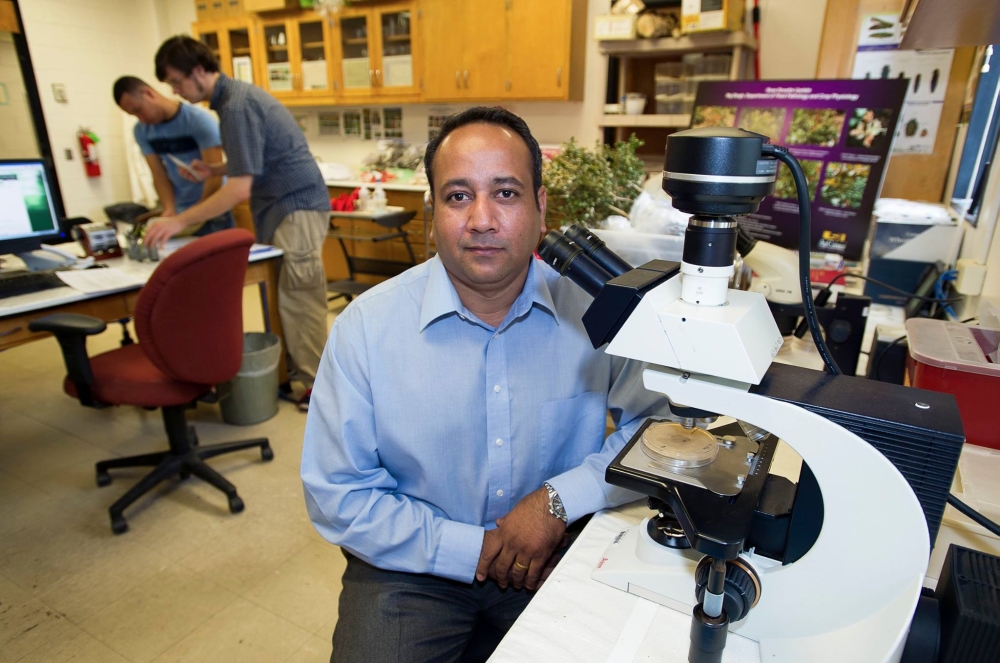
Christopher A. Clark
Professor
Research
My research is primarily directed at solving short and
long-term disease problems of the Louisiana and U.S.
sweetpotato industries, as well as research aimed at better
understanding the biology of sweetpotato pathogens and
diseases they cause. Efforts currently emphasize two
problems: the role of viruses in cultivar decline, and
efforts to improve postharvest disease control with reduced
reliance on prophylactic use of fungicides.
Role of viruses in
sweetpotato cultivar decline
It has
long been recognized that sweetpotato cultivars decline in
yield and quality performance after they are released and
even the most popular cultivars are replaced about every
15-20 years. The reasons for the decline have not been well
defined but it is thought that accumulation of viruses
and/or mutations in the planting stock is responsible.
Although sweetpotato is the seventh most important food crop
worldwide, and an economically important crop in a few
states in the U.S., including Louisiana, it has not received
the same research attention that many other crops have
enjoyed. As a result of limited investment in research, our
understanding of the viruses that infect this crop lags well
behind that for many other vegetatively propagated crops.
For many years, Sweet potato feathery mottle virus (SPFMV)
was the only virus recognized to occur in sweetpotatoes in
the U.S. However, our field studies indicate that SPFMV by
itself has minimal effect on yield of sweetpotatoes, even
though it re-infects healthy plants in the field very
rapidly. During the past 20 years, a number of other
viruses have been identified from sweetpotato, but not much
is known about their roles in cultivar decline (Valverde
et al., 2007). Therefore, our research has been
directed in part to determine what pathogens might be
interacting with SPFMV to cause cultivar decline. We found
that two other potyviruses, Sweet potato virus G (SPVG)
and Sweet potato virus 2 (SPV-2) also occur commonly in
sweetpotatoes in the southeast U.S. (Souto
et al., 2003). In addition, the whitefly-transmitted
begomoviruses, Sweet potato leaf curl virus (SPLCV)
and Sweet potato leaf curl Georgia virus, were found
to occur in ornamental sweetpotatoes and some sweetpotato
breeding lines. In field plot studies, however, none of
these viruses or combinations of them has produced the same
yield depression obtained when using ‘naturally infected’
plants from farmers’ fields as inoculum (Clark
and Hoy, 2006).

Furthermore, when titers of viruses were determined using
real-time quantitative PCR (Kokkinos
and Clark, 2006), naturally infected plants had about
200-fold greater titers of SPFMV, SPVG, and SPV-2 than
artificially inoculated Beauregard plants grown under the
same conditions:

Relative titers of Sweet
potato feathery mottle virus (SPFMV), Sweet potato virus G (SPVG),
and Sweet potato virus 2 (SPV-2) as determined by
quantitative real-time PCR. ‘Artificial’ = plants graft
inoculated with all three viruses, ‘Natural’ = plants
exposed to infection in the field for 7 years. Plants
sampled for the test were grown in the same greenhouse
conditions.
Naturally
infected plants also have more severe and persistent
symptoms than plants artificially inoculated with SPFMV,
SPVG, and SPV-2:

Left = Beauregard
sweetpotato graft inoculated with SPFMV, SPVG, and SPV-2
showing virtually no symptoms, right = Beauregard plant
derived from a source that had been exposed to natural
infection in the field for 7 years.
It now
appears that sweetpotatoes are affected by a complex of
viruses in the U.S. that is not yet fully characterized.
Effects on the crop are likely determined by the
interactions among the viruses and the sweetpotato host
plant and the timing of infection. We are continuing to try
and isolate and identify viruses from sweetpotato with the
intention of determining which ones are critical to cultivar
decline.
As
a service to the sweetpotato industry, we do meristem-tip
culture for virus therapy and subsequent indexing to produce
virus-tested plants of important cultivars and advanced
breeding lines from the LSU AgCenter breeding program.
These virus-tested plants are provided directly or through a
private company,
Certis USA, to the foundation seed programs in
Louisiana and Alabama. Sweetpotato producers now have
access to relatively clean planting material, but they must
usually increase it on their own farms for at least one year
before they have sufficient seed to plant their crop.
Re-infection with SPFMV can be very high (often 100%) during
this first year on farms, so in collaboration with Drs.
Tara Smith and
Don Ferrin, we are conducting a multi-year
survey to determine
the performance of sweetpotato seed from farmers’ programs
to determine when it is necessary for them to replace their
seed with foundation seed. We are also collaborating with
Dr. Jeff Davis in Entomology to learn more about the
dynamics of insect vector populations to identify the most
effective sources of virus inoculum and the timing of virus
spread in the field.
Sweetpotato Virus Disease (SPVD) is a disease that has long
been known in Africa and more recently in South America and
is caused by the synergistic interaction of SPFMV and the
whitefly-transmitted crinivirus, Sweet potato chlorotic
stunt virus. SPVD causes much more dramatic and
persistent symptoms in sweetpotato than are seen in the U.S.
and can cause yield reductions on U.S. cultivars of 80-90%.

Left = virus-tested
Beauregard, right = Beauregard with SPVD following
inoculation with the russet crack strain of SPFMV and the US
strain of SPCSV.
All
the essential components for SPVD appear to occur in the
U.S.: SPFMV is essentially universal in sweetpotatoes in the
U.S., several species of aphid vectors for SPFMV, including
Aphis gossypii and Myzus persicae are common
and this virus spreads rapidly in the field; SPCSV has been
found, but is not common, and its whitefly vectors
Bemisia tabaci and Trialeurodes abutilonea also
occur, but are not as abundant as the aphid vectors of SPFMV.
We are pursuing two general lines of research with SPVD: we
are working with Dr.
Don LaBonte to develop, improve and understand the
nature of resistance to SPVD, and we are trying to
understand why SPVD does not occur in the U.S. despite the
presence of the components. Charalambos Kokkinos and
Cecilia McGregor used microarray technology to determine
that >200 genes are differentially regulated in sweetpotato
affected with SPVD whereas only 12 genes were differentially
regulated by SPCSV and 3 genes by SPFMV (Kokkinos
et al., 2006). Douglas Miano at the Kenya Agricultural
Research Institute Biotechnology Centre developed molecular
markers for SPVD resistance as part of his PhD dissertation
(Miano
et al., 2008) and we are continuing to do research to
understand how resistance affects replication and
translocation of SPFMV and SPCSV in the plant. We are also
doing research into factors that affect SPVD symptom
development, such as sequence of virus infection (McGregor
et al., 2009) and a putative
transmissible suppressor of SPVD.
Integrated
management of Rhizopus soft rot
The
Zygomycete that causes Rhizopus soft rot on sweetpotato,
Rhizopus stolonifer, is an ubiquitous organism.
Rhizopus soft rot develops on sweetpotatoes that have been
cured and stored, infection occurring through wounds that
are incurred during the process of packing the storage roots
for shipment to market. It can completely decay roots in
1-2 weeks and for this reason, packers have routinely used a
fungicide, primarily dicloran (Botran®) applied to the roots
after they are washed to control the disease. Since
sweetpotato is the most popular baby food and since it is
also popular with people trying to follow a health-conscious
diet, reliance on prophylactic application of a fungicide at
the last stage in packing is undesirable. We are therefore
doing research to try and develop an integrated management
approach to improve management of Rhizopus soft rot while
reducing reliance on fungicides.
Resistance is often used for managing diseases, but there
had been little effort to investigate resistance to
postharvest diseases, especially in sweetpotato. We
developed methods for screening for Rhizopus soft rot
resistance and found that Beauregard, the dominant cultivar
in U.S. production from 1988-2008 had greater resistance
than earlier cultivars (Clark and Hoy, 1994). However,
despite its resistance, Rhizopus soft rot can still occur on
Beauregard, and we are working with Dr.
Don LaBonte to develop lines with greater levels of
resistance that are horticulturally acceptable.

A
Sweetpotato IPM Project was funded by the USDA Risk
Avoidance and Mitigation Program (RAMP) and Gerber Foods
that involved plant pathologists and entomologists from the
LSU AgCenter, North Carolina State University, Mississippi
State University, and Auburn University in a major program
to address problems with soil insects and postharvest
diseases. Factors investigated in relation to Rhizopus soft
rot included the role of wounds incurred on packing lines,
the effect of postharvest environment, and the effect of
preharvest environmental factors and cultural practices on
disease. Smart Spud® devices that measure impacts were used
on packing lines in Louisiana and North Carolina to identify
problem areas. Results from these studies along with
recommendations on other aspects of postharvest handling
were summarized in an extension bulletin prepared by the
participants from North Carolina and Louisiana (Edmunds
et al., 2008).

During 2004-2006, research was
conducted in plots in over 20 fields per year on commercial
sweetpotato farms in Louisiana, and a similar number were
conducted by colleagues in North Carolina, all growing
Beauregard. Sweetpotatoes harvested from these plots were
cured for 5 days, then stored at 60oF for 100-120
days and inoculated with R. stolonifer and Dickeya
didantii (syn. Erwinia chrysanthemi) using a
standardized wounding techniques and uniform inoculum. Data
were also collected from each of these plots for various
weather parameters, soil analyses, and cultural practices
followed by the producer. The results indicated that
differences in the preharvest environment have dramatic
effects on susceptibility of Beauregard sweetpotatoes to
both diseases, but also indicates that the two diseases
respond differently to the environment.

Incidence of Rhizopus soft
rot and Bacterial soft rot in Beauregard sweetpotatoes
harvested from 21 different fields in Louisiana in 2006.
The roots were cured, stored, and inoculated under identical
conditions.
Various
statistical analyses of the data from these plots indicated
that certain weather variables such as soil and air
temperature and soil moisture and soil constituents such as
calcium, phosphorus, potassium, and organic matter may
influence susceptibility of Beauregard to Rhizopus soft
rot. Research is ongoing to verify the role of these
variables and determine their interactions. Dr.
Arthur Villordon at the
Sweet Potato Research Station has used the yield data
from the same plots to help develop a growing degree day
model for determining optimal harvest time of sweetpotato (Villordon
et al., 2009) and is working on a model to determine
optimal planting time. Eventually, we would like to combine
these into a production model that producers can use to best
manage their practices.
We also
are evaluating other materials and practices that can be
used on packing lines to reduce Rhizopus soft rot. This
includes evaluation of commercial ‘reduced risk’ fungicides
and biological controls. We are also working with Dr.
Dave Picha to evaluate the potential for using hot
water.
Streptomyces soil rot
Streptomyces
soil rot disease, which is caused by the soil-borne
actinomycete, Streptomyces ipomoeae was the most
significant disease problem on sweetpotatoes in the U.S.
prior to the development of resistant cultivars by the LSU
AgCenter. Early on we determined that this pathogen is one
of very few prokaryotic pathogens with the ability to
directly penetrate plants (Clark and Matthews, 1987). We
also found that strains of this pathogen collected from
various locations in the U.S. and Japan were relatively
homogeneous when compared using rep-PCR and plasmid
profiling (Clark
et al., 1998). However, they could be divided into
three groups based on inhibitory interaction phenotypes.
Gregg Pettis in the Department of Biological Sciences
has an interest in molecular biology of Streptomyces
species and taken this area of research into a molecular
study of the inhibitory phenomena that involves production
of a bacteriocin-like substance, ipomicin and is actively
investigating the mechanisms of pathogenicity in this
organism.
Development of
Disease-resistant cultivars
The LSU
AgCenter sweetpotato breeding program is a highly productive
team effort involving scientists in the School of Plant,
Environmental, and Soil Sciences, the Sweet Potato Research
Station, and the Departments of Plant Pathology & Crop
Physiology and Entomology. Breeding lines from this program
are screened for resistance to multiple diseases including
Streptomyces soil rot, Fusarium wilt, internal cork,
root-knot nematode, bacterial root and stem rot, Fusarium
root rot, and others. The LSU AgCenter program has been
the primary source of resistance to Streptomyces soil rot
and has released a number of cultivars, some of which have
been very widely adopted by the industry. The most notable
example is Beauregard which accounted for >80% of U.S.
sweetpotato acreage during the period 1988-2006. Since
1980, the following cultivars have been released all of
which are resistant to Fusarium wilt and Streptomyces soil
rot and have other disease resistance as well:
1980 - Travis (L74-62) - grown
on limited acreage in LA for several years
1981 - Eureka (L74-131) -
grown on limited acreage in CA for several years
1987 - Beauregard (L82-508) -
grown on approx. 80% of US acreage 1990-2005, also grown in
Australia and New Zealand.
1992 - Hernandez (L82-66) -
grown on approx. 5-10% of US acreage since 1995, mostly in
NC
1994 - L86-33 - used as a
source of multiple disease and pest resistance in U.S. and
international breeding programs
1995 - Darby (L87-59) - not
grown commercially to any significant extent
2001 - L96-117 - Patent No. US
PP 15,038 P2 awarded to LaBonte, D., Wilson, P., Clark, C.,
Villordon, A., and Cannon, J.
2002 -
Bienville (L94-96) - Patent No. US PP 15,580 P3 awarded
to LaBonte, D., Wilson, P., Clark, C., Villordon, A.,
Cannon, J., Story, R., and Hammond, A.
2007 -
Evangeline (L99-35) – U. S. Patent Ser. No. 11/789,681
awarded to LaBonte, D., Villordon, A., Clark, C.
2007 -
Muraski-29 (L01-29) – U. S. Patent Ser. No. 11/975,203
awarded to LaBonte, D., Villordon, A., Clark, C.

Left = the susceptible
cultivar Centennial, and right = a resistant breeding line
growing in the Streptomyces soil rot nursery.
[previous page]
|